What is Passive House?
A measurable building standard for year-round comfort and very low energy demand — adapted to the project and climate, including South Australia.
By Jonathen Hindry · Published 26 May 2026 · Updated 11 September 2026 · 12 min read
Passive House in one paragraph
Passive House — or Passivhaus — is a voluntary, performance-based building standard developed by the Passive House Institute. The design is modelled in PHPP, the construction is documented and key outcomes are verified, including a final blower door test. It is not an architectural style, a brand of product or simply a north-facing home with thermal mass.
Passive House, passive solar and high-performance are different terms
Certified Passive House
A defined standard assessed against Passive House Institute criteria by an accredited certifier, using modelling, documentation and testing.
Passive solar design
A design approach that uses orientation, sun, shading, thermal mass and natural ventilation. These strategies can support a Passive House, but they do not create certification by themselves.
High-performance home
A broad, unregulated description. It can describe an excellent measured home, but the claim needs project-specific targets and evidence. Read our Australian high-performance checklist.
The five building principles
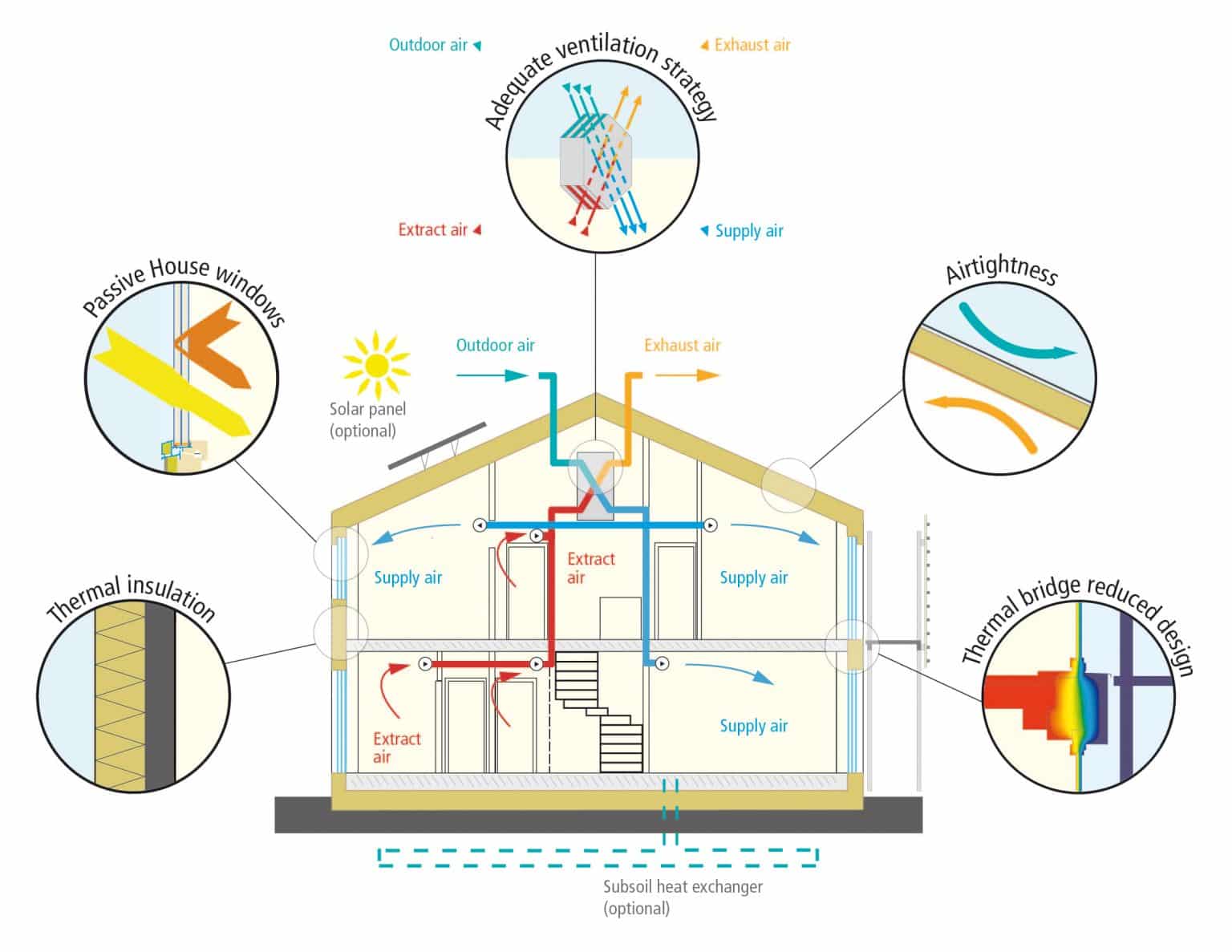
Climate-appropriate insulation
A continuous thermal layer reduces heat flow through the roof, walls and floor. The appropriate level and assembly depend on climate, form and the rest of the design.
Airtight construction
One continuous air barrier limits uncontrolled air movement through the envelope. Certified Passive House projects must achieve an n₅₀ airtightness result of 0.6 h⁻¹ or better.
High-performance windows
Efficient glazing and frames are selected as part of the energy model, then installed within the insulation and air-barrier strategy. Triple glazing is common, but the correct specification is climate and project dependent.
Thermal-bridge-reduced detailing
Junctions are designed so heat cannot easily bypass the insulation. This helps protect comfort, energy performance and internal surface temperatures.
Ventilation with heat recovery
Balanced mechanical ventilation supplies filtered outdoor air and extracts stale air while recovering heat. It is designed and commissioned for air quality, comfort, efficiency and low noise.
What does certification measure?
Certification checks more than the familiar 0.6 ACH50 airtightness threshold. Current criteria assess heating and cooling demand or load, renewable primary energy demand, moisture and comfort requirements, and — for Plus and Premium classes — renewable energy generation. Exact limits and allowances depend on building type, climate and the current Passive House Institute criteria, so PHPP and the project certifier are the source of truth.
Important: the five principles explain how the standard is achieved; they are not a substitute for its certification criteria. A home can use all five principles and still be uncertified, or miss a criterion if the design and construction are not verified.
How a project becomes certified
- 1
Set the target early
Appoint an experienced designer and certifier before the envelope and building-services decisions are fixed.
- 2
Model the building in PHPP
Enter geometry, climate, windows, shading, assemblies, ventilation and systems into the Passive House Planning Package.
- 3
Resolve the details
Document the insulation, airtightness and thermal-bridge strategy at every important junction and penetration.
- 4
Review during construction
Keep product evidence and photographs, inspect concealed details and carry out an interim blower door test while leaks are accessible.
- 5
Commission and verify
Complete final airtightness testing, ventilation balancing and the evidence package required by the project certifier.
What changes in South Australia?
Passive House is climate-specific. South Australian design must manage strong summer sun and cooling demand as carefully as winter heat loss. Window area, orientation, external shading and glass specification are modelled rather than copied from central-European examples. Natural ventilation can still be used when conditions suit, while MVHR provides reliable filtered ventilation when windows are closed.
Construction sequencing is just as important as modelling. The air barrier and insulation need named responsibility, buildable junction details and testing before finishes conceal the work. HiPer Haus contributes blower door testing, MVHR design and commissioning, and heat-pump hot-water systems within the wider project team.
Thebarton
Certified Passivhaus
South Australian projectMount Barker
Certified Passivhaus Plus display home
South Australian projectTorrens Park
Certified Passivhaus
Costs and trade-offs
There is no reliable universal Passive House cost premium. Form, glazing area, construction system, documentation quality, team experience and when decisions are made all affect cost. Compact forms and early coordination can offset upgrades; late redesign, oversized glazing and difficult junctions can add cost quickly.
Certification also adds modelling, review, evidence and testing. The return is a quality-assurance process and a defined result, not a guarantee that every product choice will be cheaper or that occupants will never need heating or cooling.
Primary references
Planning a Passive House or high-performance build?
Bring airtightness, ventilation and commissioning into the project before the important details are locked in.
Written by
Jonathen HindryFounder of HiPer Haus. ATTMA Level 1 Airtightness Tester, Certified Passive House Tradesperson and 25+ year plumber — blower door testing, MVHR design and heat pump hot water across Adelaide and South Australia.
