What is Passive House?
The world's most rigorous and scientifically proven building energy standard — and why it delivers homes that are genuinely comfortable.
The standard, explained
Passive House (Passivhaus) is a building energy standard developed in Germany in the 1990s by physicist Dr. Wolfgang Feist. Unlike rating systems that estimate performance based on design, Passive House is based on verified measured performance — with strict limits on energy demand, peak load and airtightness.
A certified Passive House home requires very little energy to maintain comfortable temperatures year-round — typically 75–90% less heating energy than a conventional home. This is achieved not through complex active technology, but by designing the building fabric to do the work.
Passive House is used in more than 60 countries and has been applied to thousands of buildings — from modest family homes to large apartment buildings and schools.
The five principles
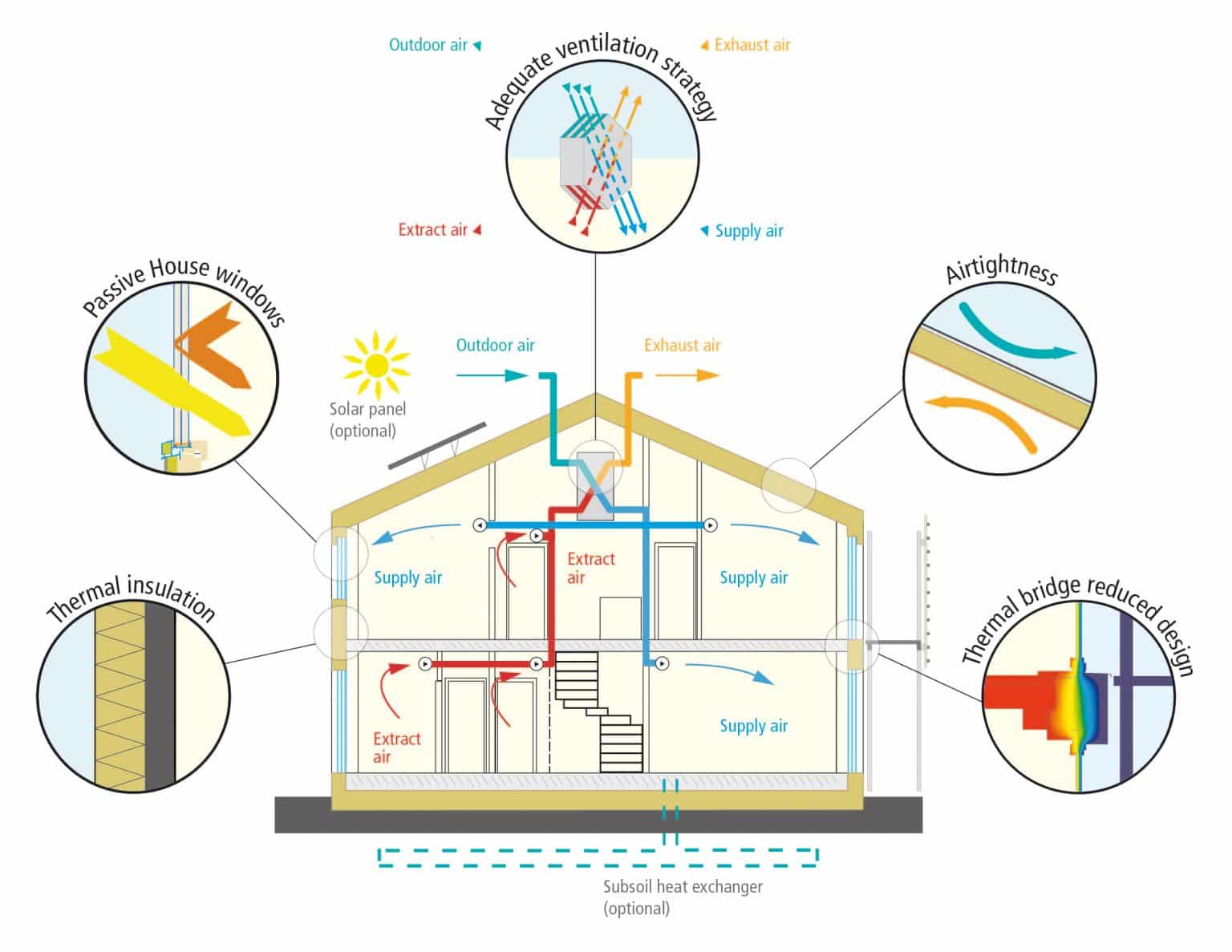
Superior insulation
Thick, continuous insulation around the entire building envelope — walls, roof and floor slab — eliminates thermal bridges and dramatically reduces heat loss.
Airtight construction
The building is sealed to achieve very low air leakage, typically ≤0.6 ACH50. This eliminates draughts and uncontrolled moisture movement.
High-performance windows
Triple-glazed, thermally broken windows and doors prevent radiant heat loss and cold surface condensation.
Thermal bridge free detailing
All junctions between building elements are designed to eliminate or minimise thermal bridges — the weak points that allow heat to bypass insulation.
Mechanical Ventilation with Heat Recovery
MVHR provides continuous fresh, filtered air while recovering heat from outgoing stale air — the essential ventilation solution for an airtight building.
Why does it matter for comfort?
Passive House homes feel different. The combination of airtightness, MVHR and high-performance glazing means there are no cold spots, no draughts, no humidity spikes and no stuffy rooms. The indoor environment is genuinely stable and comfortable — not just energy-efficient on paper.
Internal surface temperatures on walls and windows remain close to room air temperature, eliminating the feeling of cold radiation from external walls on winter nights — a common complaint in standard construction.
Passive House standards
Passive House certification isn’t one-size-fits-all. Different standards recognise the unique needs of new builds and retrofits, as well as projects that go beyond efficiency into renewable energy generation. All share the same underlying principles of comfort, durability and low energy demand.
Passive House Classic
The original benchmark. Classic ensures ultra-low energy demand, stable indoor temperatures and year-round comfort while cutting running costs dramatically. The standard most people mean when they say ‘Passive House’.
Passive House Plus
Building on Classic, Plus recognises projects that also generate renewable energy on-site — homes and buildings that not only save energy but actively contribute back to the grid.
Passive House Premium
The highest level of certification, highlighting buildings with exceptional efficiency and large contributions from renewables. These projects set the standard for future-ready, energy-positive design.
EnerPHit — The Retrofit Standard
Designed for existing buildings, EnerPHit adapts Passive House principles to the realities of renovation. It provides a practical pathway to upgrade comfort, air quality and efficiency in older homes and commercial spaces where achieving full Classic criteria isn’t feasible due to existing structural constraints.


Passive House in South Australia
Passive House is increasingly popular in South Australia — driven by interest in low-energy homes, solar PV optimisation and real comfort performance. The principles work well in the South Australian climate, with solar gain management and cross-ventilation strategies adapted for local conditions.
HiPer Haus has Certified Passive House Tradespeople on the team that have worked on Passive House and High Performance home projects across Adelaide and the Hills. We understand what the standard actually requires and how to achieve it in practice.
Go deeper on the two principles that decide the result
Written by
Jonathen HindryFounder of HiPer Haus. ATTMA Level 1 Airtightness Tester, Certified Passive House Tradesperson and 25+ year plumber — blower door testing, MVHR design and heat pump hot water across Adelaide and South Australia.
