Blower Door Testing Adelaide Hills
Airtightness testing built for the Hills — cold winters, bushfire-rated construction and the high-performance homes that suit a genuinely cool climate. Independent ATTMA / ISO 9972 reports across Stirling, Aldgate, Hahndorf, Nairne and Mount Barker.
- Cold-climate focus
- BAL & bushfire builds
- Passive House experience
- ATTMA Level 1 Airtightness Tester
A cooler climate changes what a good envelope has to do
HiPer Haus tests right across the Adelaide Hills, from the cool, leafy central towns of Stirling, Aldgate and Crafers through to Hahndorf, Nairne, Littlehampton and the growing residential edges of Mount Barker. We are a South Australian company based on the doorstep of the Hills, and it is one of the regions where airtightness testing makes the clearest difference — because the climate here is meaningfully different to the plains below.
The Hills run several degrees colder than metropolitan Adelaide. Winters are long, frosts are regular, and humidity sits high through the cold months. That combination is exactly the condition under which a leaky home struggles: heat escapes through every gap, cold damp air is drawn in, and warm moist indoor air pushed into cold cavities can condense. A blower door test is the tool that turns those risks into a measured number and a map of where the air is moving.
Hills housing spans two very different worlds. On one side are the heritage stone and timber cottages of the older townships — beautiful, but built with no air barrier at all, leaking through suspended floors, chimneys and original joinery. On the other is a wave of new construction: bushfire-rated (BAL) builds detailed to keep embers out, architect-designed custom homes taking advantage of the views, and a notable concentration of high-performance and certified Passive House projects, drawn here precisely because a cold climate makes a tight, well-insulated envelope pay for itself.
The four themes that shape testing in the Hills — bushfire construction, cold winters, condensation risk and high-performance homes — run through everything below.
Sealing for embers also seals for air
Much of the Hills is bushfire-prone, so new homes are built to a BAL rating with ember-proof detailing — sealed gaps, screened vents, tight junctions and no open paths into roof or subfloor spaces. Those measures overlap strongly with good airtightness. A blower door test verifies that the work fitted for bushfire compliance is also delivering a measurably tighter envelope, and the smoke-pencil diagnostics confirm there are no remaining gaps at junctions where embers — or air — could still pass.
It is a rare case where a regulatory requirement and a performance goal point in the same direction. Testing makes the overlap visible and documented.
The risk that hides inside the walls
In a cold, humid Hills winter, warm moist indoor air will move towards anywhere cold. Where it leaks into a cool wall or roof cavity it can condense, feeding mould and slowly damaging the structure — often without ever showing on the surface. This interstitial condensation is one of the quiet failure modes of cold-climate homes.
Controlling air leakage is central to managing it. A blower door test finds the leakage paths that carry moist air into the structure so they can be sealed. More on condensation risk →
What a blower door test is — and how it works
A blower door test measures uncontrolled air leakage through a building envelope. A calibrated fan is fitted into an external doorway and holds the home at a 50 Pascal reference pressure — about the effect of a steady wind. The airflow needed to maintain that pressure is the sum of every gap in the walls, roof and floor.
Results are given as ACH50 (air changes per hour at 50 Pascals) and q50 (m³/h per m² of envelope). Passive House uses ACH50; NCC compliance often uses q50. Every report includes both with the calibration records.
Why builders use it: in a cold climate the air barrier is doing real work, and a test confirms it was built as drawn before the lining hides it.
Why homeowners use it: it explains why a Hills home is hard to heat or why a back room never warms up, and shows where to seal.
Who needs one: Passive House and EnerPHit projects (mandatory), builders supporting NCC verification, anyone installing MVHR, and owners of older Hills cottages wanting a baseline before a renovation.
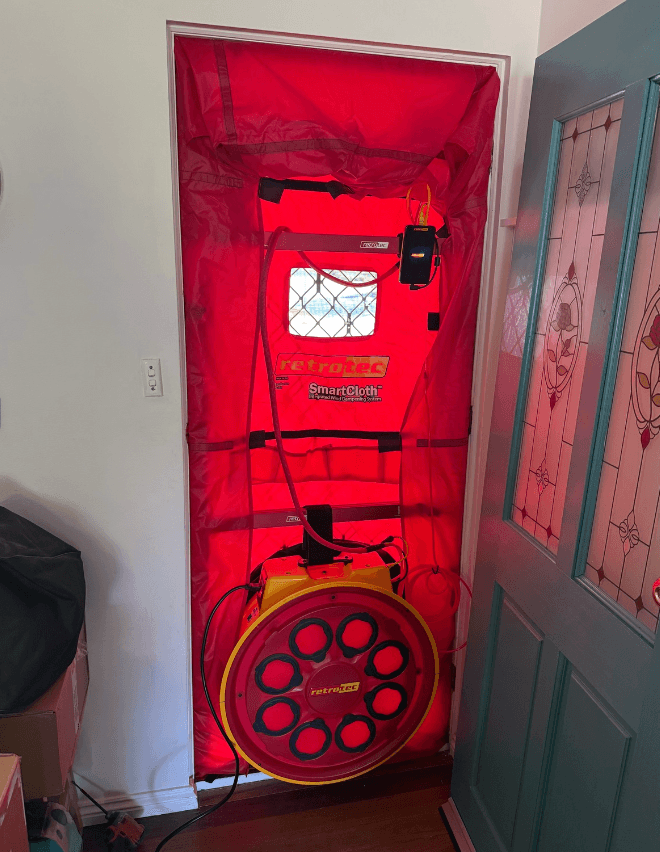
How testing applies to Hills projects
New homes
BAL-rated new builds in the Hills already seal for embers; a pre-lining test confirms the same detailing is delivering airtightness, and the result protects the NCC energy assessment in a climate where heating dominates.
Renovations
Heritage stone and timber cottages in Stirling, Aldgate and Hahndorf leak heavily. Testing before and after draught-sealing and air-barrier work quantifies exactly what each upgrade delivered.
Passive House
The Hills' cold climate makes Passive House genuinely worthwhile. We run interim tests through construction and the mandatory final test below 0.6 ACH50, with certifier-ready reporting.
EnerPHit retrofits
Deep retrofits of old Hills homes to EnerPHit's 1.0 ACH50 are demanding work. Staged testing finds the leaks at chimneys, floors and roof junctions before they are concealed again.
High-performance homes
Custom Hills homes often pair a defined airtightness target with designed ventilation. A test verifies the specified envelope result and informs commissioning.
Volume builders & architects
Project-home builders use a test for NCC support; Hills architects use an airtightness schematic plus a verifying test to hold cold-climate detailing across multiple trades.
Where Hills homes commonly leak
The Hills’ mix of heritage cottages and cold-climate new builds produces a distinctive set of leakage paths. These are the ones that matter most given the climate.
Roof-to-wall junctions
In a cold climate the junction where the roof meets the external wall is both a major heat-loss path and the place warm moist air escapes into a cold roof space — the classic condensation risk. It is one of the first places we check under smoke.
Recessed downlights into cold roof spaces
Each downlight is an open hole into an unheated, often frost-cold roof void. In a Hills winter that is a direct path for warm air to escape and for the ceiling plane to underperform.
Suspended timber floors & subfloor penetrations
Older Hills cottages sit on suspended floors over a cold, ventilated subfloor. Gaps around floorboards, skirtings and floor penetrations draw cold air straight up into living spaces.
Open chimneys & flues
Heritage Hills homes frequently retain original chimneys. An uncapped flue is a permanent open path to outside — a significant single leak that smoke testing makes obvious immediately.
Large glazed openings to the view
Hills homes are oriented to the outlook with wide sliding and stacker doors. Their tracks, stiles and reveals are a frequent leak, and the linear metres of seal grow with every extra panel.
Ceiling hatches & service penetrations
Manhole hatches and plumbing, electrical and flue penetrations into the roof are common unsealed gaps. In a cold roof they undermine both the air barrier and the insulation around them.
Need a price for your Hills project?
Enter your details below for an indicative cost in under a minute. Final pricing — including any modest travel for the more distant towns — is confirmed in your formal quote.
Indicative testing price
$880
incl GST · indicative estimate
Includes the calibrated test, on-site leak investigation, measured results and written report.
Check availability for your project
Send us the essentials and we’ll confirm the test scope, price and available dates.
Testing services available in the Hills
Pre-lining testing
Mid-construction diagnostic before plasterboard, when cold-climate detailing can still be sealed.
Final testing
Completion test documenting ACH50 / q50 for handover, NCC or certification.
ATTMA testing
Reports to ATTMA TSL1 methodology and format.
ISO 9972 testing
Testing to the ISO 9972 international standard.
Leakage investigation
Smoke-pencil diagnostics targeting cold-climate leakage and condensation paths.
Smoke testing
Visual confirmation of air movement at junctions and penetrations.
Thermal imaging
Especially effective on frosty Hills mornings, revealing hidden insulation and air gaps.
Compliance testing
Documented air-permeability results to support H6V3 or another nominated project pathway.
Why Hills builders and homeowners choose HiPer Haus
ATTMA Level 1 Airtightness Tester
Accredited testing and reporting to ATTMA TSL1 / ISO 9972 with full calibration records.
Passive House experience
Certified Passive House tradesperson experience — relevant to the Hills' high-performance projects.
Practical construction knowledge
We understand how BAL detailing and cold-climate builds go together.
Detailed reporting
Plain-English findings plus a documented report formatted for your pathway.
South Australian company
Based on the edge of the Hills, so attendance is straightforward.
Independent testing
No product agenda — just the measured result and honest next steps.
Builder friendly
We work around build programmes and talk directly with trades on site.
Homeowner friendly
We explain what the result means for comfort and heating in plain terms.
Across the Adelaide Hills
From the central Hills towns to the eastern districts around Mount Barker, we test wherever the cold-climate envelope matters. We have carried out blower door testing in the Hills, including a documented test at Nairne. Neighbouring regions are covered on our Adelaide and Barossa pages.
Adelaide Hills blower door testing — frequently asked questions
Learn more about airtightness
Blower Door Testing — main service
Pricing, methodology, what's included and the instant quote tool.
Condensation on new windows
Why the Hills' cold, humid winters drive condensation and how to manage it.
Mould in new homes
How air leakage and moisture combine to create mould risk in cold climates.
What is Passive House?
The cold-climate standard behind the 0.6 ACH50 target.
High-performance homes
What makes a home perform in a genuinely cool climate like the Hills.
Airtightness explained
Why uncontrolled air leakage drives heat loss and comfort problems.
Blower door testing in other South Australian regions
We test right across the state. If your project sits outside this region, these guides cover the local housing styles, climate and common leakage points in each area.
Adelaide
Metro new builds, custom homes and volume builders.
View Adelaide →Barossa Valley
Custom homes, straw bale and high thermal mass.
View Barossa Valley →Fleurieu Peninsula
Coastal homes, sea winds and salt-air durability.
View Fleurieu Peninsula →Mount Gambier
Limestone homes, a windy climate and colder temperatures.
View Mount Gambier →Riverland
Extreme heat, cooling loads and dust infiltration.
View Riverland →Talk to HiPer Haus about testing in the Adelaide Hills
Tell us about your Hills build, cold-climate renovation or Passive House project and we’ll confirm timing, method and pricing for your town.