Blower Door Testing Adelaide
Independent, calibrated airtightness testing for new builds, renovations and Passive House projects right across metropolitan Adelaide — with written ATTMA / ISO 9972 reports and practical, build-aware advice.
- ATTMA Level 1 Airtightness Tester
- No metro travel charge
- Passive House experience
- Detailed written reports
Airtightness testing for the way Adelaide builds
HiPer Haus is a South Australian building-performance company, and metropolitan Adelaide is where we do most of our work. We test new homes from the northern growth corridors around Gawler and Munno Para through to the established eastern and foothills suburbs, the coastal west, and the southern expansion towards Aldinga. Because the city is our base, blower door testing inside the metro area carries no regional travel cost — which makes a pre-lining test, and the follow-up it sometimes prompts, an easy thing to fit into an Adelaide build programme.
Adelaide’s housing stock is unusually varied for an Australian capital. A single street in Unley or Prospect can hold a solid double-brick villa from the 1920s, a postwar cream-brick cottage and a contemporary infill build, each leaking air in a completely different way. New estates in the north and south are dominated by slab-on-ground brick-veneer project homes built to NCC 2022. Between the two sit the architect-designed custom homes of the eastern suburbs and the small but growing number of certified Passive House and high-performance builds appearing across the city. A blower door test reads each of these honestly, regardless of how it was marketed.
Airtightness matters in Adelaide for reasons that work in both directions across the year. The summers are hot and dry, with multi-day runs above 40°C that push hard on cooling and drive hot outside air into any home that leaks. The winters are cool and damp, and an Adelaide home that exchanges its air uncontrollably through gaps loses heat steadily and invites condensation on cold mornings. A measured, controlled envelope is what lets a home stay comfortable on a February heatwave and a July night without simply running the reverse-cycle harder.
The four broad project types we test in Adelaide — NCC 2022 project homes, architect-designed custom builds, Passive House and high-performance homes, and volume-builder estates — each bring their own leakage signature and their own reasons for testing, which is what the rest of this page works through.
What a blower door test is — and how it works
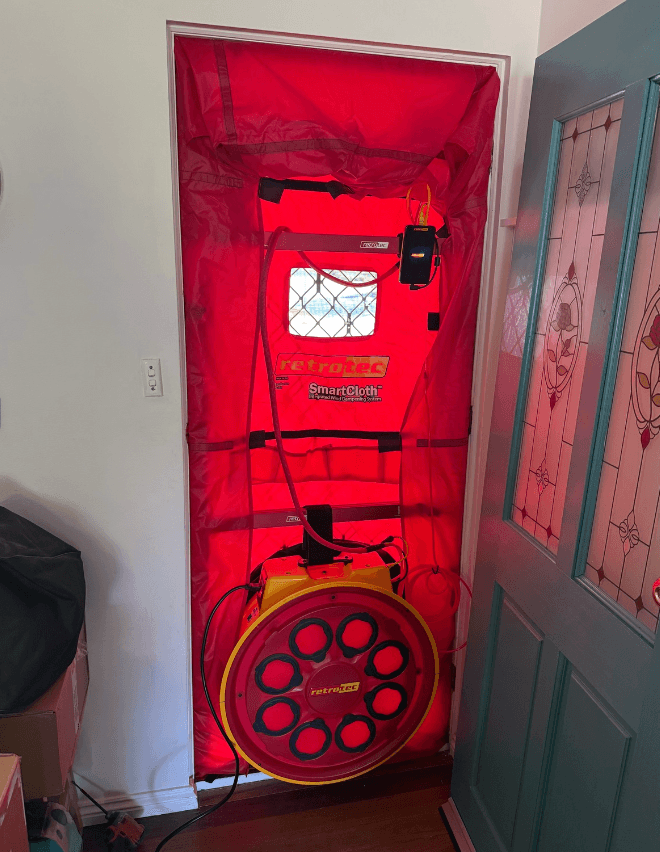
A blower door test measures how much uncontrolled air leaks through a building’s envelope. A calibrated fan is fitted into an external doorway on an adjustable frame and used to hold the building at a reference pressure of 50 Pascals — roughly the effect of a steady wind on one wall. The volume of air the fan has to move to maintain that pressure is the total of every crack, gap and penetration in the walls, roof and floor.
The result is reported as ACH50 (air changes per hour at 50 Pascals, referenced to the internal volume) and q50 (m³/h per m² of envelope area). Passive House uses ACH50; NCC energy compliance often uses q50. Every HiPer Haus report includes both, with the calibration records behind them.
Why builders use it: a test confirms the air barrier was actually built the way it was drawn. Run before plasterboard is lined, it catches problems while they are still cheap to fix and protects the energy-model assumptions the project relies on.
Why homeowners use it: it turns vague complaints — draughts, dust, a room that never warms up, condensation on the glass — into a measured number and a map of exactly where the air is moving, so money goes towards the gaps that matter.
Who needs one: any Passive House or EnerPHit project (it is mandatory), builders supporting NCC 2022 energy verification, anyone installing MVHR who needs the envelope tight enough for it to work, and homeowners renovating an older Adelaide home who want a baseline before and after.
NCC 2022 includes a measured building-envelope sealing pathway. H6V3 uses an air-permeability result in m³/(h·m²) and requires mechanical ventilation when its threshold is met. That result is different from ACH50, even though both can be obtained during blower door testing. What NCC 2022 means for SA homes →
How testing applies across Adelaide projects
New homes
Slab-on-ground brick-veneer homes in the northern and southern growth corridors benefit most from a pre-lining test — the wrap, tapes and penetration seals are all still accessible, and the result protects the NCC energy assessment the build was approved against.
Renovations
Adelaide's solid-wall villas and postwar cottages are heavy air leakers. Testing before works gives a baseline; testing after confirms what the new windows, draught sealing and ceiling work actually delivered, rather than assuming.
Passive House
Adelaide's small but growing cohort of certified projects needs a final test below 0.6 ACH50. We work to the certifier's reporting format and can run interim tests through construction to keep the envelope on track.
EnerPHit retrofits
For deep retrofits of older Adelaide homes pursuing EnerPHit, the 1.0 ACH50 target is demanding on a building that was never designed to be airtight. Staged testing finds the weak junctions — original floors, chimneys, service runs — before they are concealed again.
High-performance homes
Custom builds in the eastern and foothills suburbs often pair a defined airtightness target with designed ventilation. Testing verifies the specified target instead of relying on assumptions.
Volume builders & architects
Project-home builders use a test to support NCC compliance and demonstrate delivered quality; architects use an early airtightness schematic plus a verifying test to hold the build to the design intent across many trades.
Where Adelaide homes commonly leak
Every house is different, but the leakage paths we find in Adelaide cluster around a handful of details that recur because of how the city builds and renovates. These are the ones worth knowing before your test.
Recessed downlights
Adelaide ceilings are full of them, and each penetration is an open path into a vented roof space. In single-storey homes with a large ceiling area relative to volume, downlights are often the single biggest contributor to a high result.
Sliding and stacker doors
The indoor-outdoor living that defines newer Adelaide homes means wide aluminium sliding and stacker doors. Their meeting stiles, sill tracks and head reveals are a frequent leak — the wider the opening, the more linear metres of seal there are to get wrong.
Slab-to-frame junction
On slab-on-ground brick veneer — the dominant Adelaide build — the joint where the timber bottom plate meets the concrete slab is a continuous potential leak if the membrane and sealing were not detailed carefully.
Service penetrations
Plumbing, electrical, gas and air-conditioning penetrations through external walls and the ceiling are often foamed roughly or left open above the ceiling lining. They show up clearly under smoke when the home is depressurised.
Exhaust fans and range hoods
Bathroom fans and kitchen range hoods that vent to outside are frequently fitted without a backdraught seal, leaving an unsealed duct straight to the roof or eave. In an airtight home this also affects how the range hood draws makeup air.
Ceiling hatches & original windows
Manhole access hatches are a classic uninsulated, unsealed gap into the roof. In Adelaide's older suburbs, original timber double-hung windows add to this — decades of paint and movement leave gaps at the meeting rail and sash.
For more on why range hoods and exhaust fans behave differently in a tight home, see our Range Hood Makeup Air Calculator and the explainer on range hoods in airtight homes.
Need a price for your Adelaide project?
Use the instant estimate tool below for an indicative cost in under a minute. Final pricing is confirmed in your formal quote — and for metro Adelaide there is generally no travel charge.
Indicative testing price
$880
incl GST · indicative estimate
Includes the calibrated test, on-site leak investigation, measured results and written report.
Check availability for your project
Send us the essentials and we’ll confirm the test scope, price and available dates.
Testing services available in Adelaide
Pre-lining testing
Mid-construction diagnostic before plasterboard, when leaks are still cheap to seal.
Final testing
Completion test documenting the achieved ACH50 / q50 for handover, NCC or certification.
ATTMA testing
Reports prepared to ATTMA TSL1 methodology and format.
ISO 9972 testing
Testing carried out to the ISO 9972 international standard.
Leakage investigation
Smoke-pencil diagnostics to locate and prioritise the dominant leakage paths.
Smoke testing
Visual confirmation of air movement at junctions, penetrations and reveals.
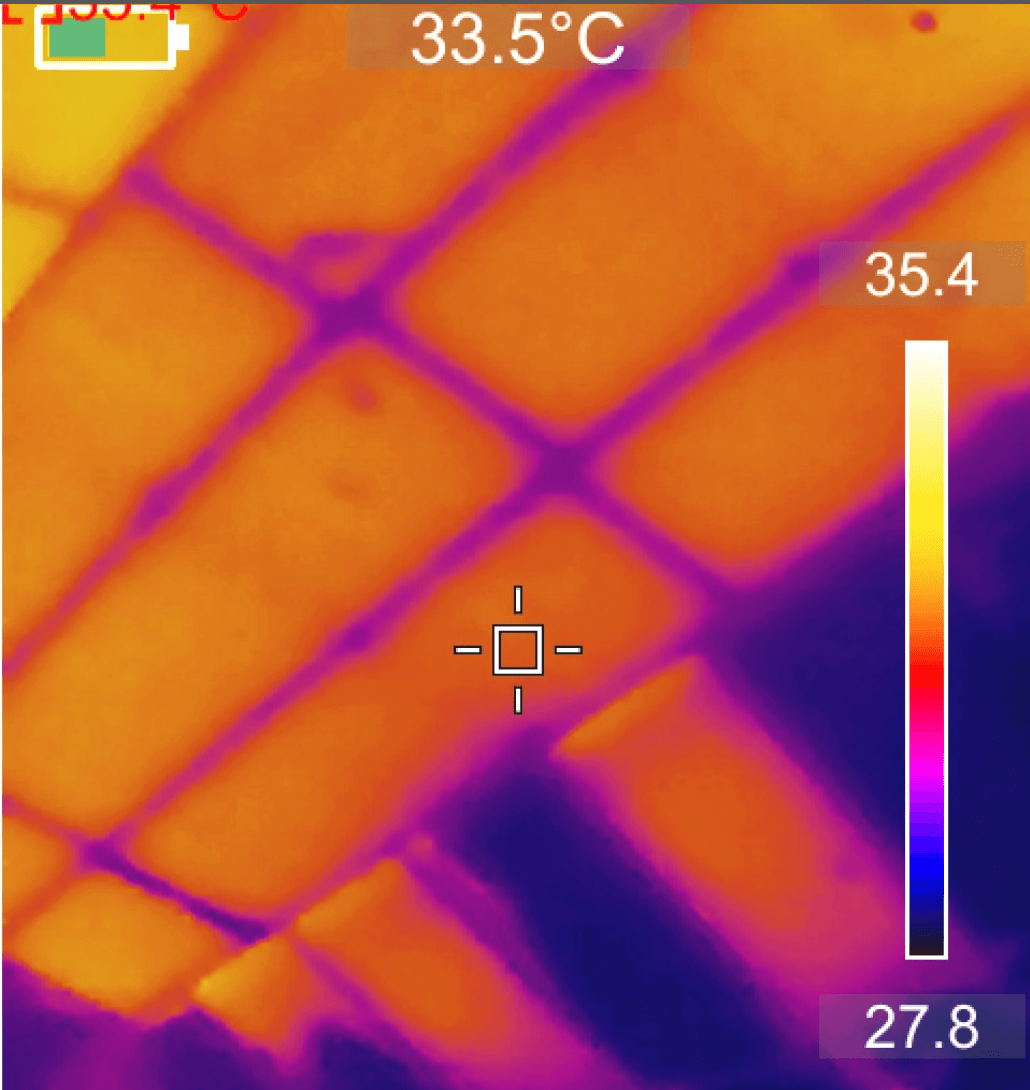
Thermal imaging
Added on cool mornings to reveal hidden insulation gaps alongside air leaks.
Compliance testing
Documented air-permeability results to support H6V3 or another nominated project pathway.
Why Adelaide builders and homeowners choose HiPer Haus
ATTMA Level 1 Airtightness Tester
Accredited testing and reporting to ATTMA TSL1 / ISO 9972 with full calibration records.
Passive House experience
Certified Passive House tradesperson experience and a working knowledge of certification requirements.
Practical construction knowledge
We read results through how Adelaide homes are actually built, not just the numbers.
Detailed reporting
Plain-English findings plus a documented report formatted for your pathway.
South Australian company
Adelaide-based, so metro testing carries no regional travel cost.
Independent testing
No product sales agenda — just the measured result and honest next steps.
Builder friendly
We fit around build programmes and talk directly with your trades on site.
Homeowner friendly
We explain what the result means for your home in language that makes sense.
Across metropolitan Adelaide
We test right across the metro area — from the foothills to the coast and from Gawler to Aldinga. Travelling beyond the metropolitan boundary? Our dedicated regional pages cover the Adelaide Hills, Barossa Valley, Fleurieu Peninsula and Riverland.
Adelaide blower door testing — frequently asked questions
Learn more about airtightness
Blower Door Testing — main service
Pricing, methodology, what's included and the instant quote tool.
Airtightness explained
Why uncontrolled air leakage drives heat loss, comfort and moisture problems.
What is Passive House?
The standard behind the 0.6 ACH50 airtightness requirement.
Condensation on new windows
How air leakage and moisture combine on Adelaide's cool winter mornings.
NCC 2022 for SA homes
What the energy and ventilation provisions mean for Adelaide builds.
Bedroom CO₂ Calculator
Why a tight home needs planned ventilation to keep bedroom air fresh.
Blower door testing in other South Australian regions
We test right across the state. If your project sits outside this region, these guides cover the local housing styles, climate and common leakage points in each area.
Adelaide Hills
Cold winters, bushfire construction and condensation risk.
View Adelaide Hills →Barossa Valley
Custom homes, straw bale and high thermal mass.
View Barossa Valley →Fleurieu Peninsula
Coastal homes, sea winds and salt-air durability.
View Fleurieu Peninsula →Mount Gambier
Limestone homes, a windy climate and colder temperatures.
View Mount Gambier →Riverland
Extreme heat, cooling loads and dust infiltration.
View Riverland →Talk to HiPer Haus about testing in Adelaide
Tell us about your Adelaide build, renovation or Passive House project and we’ll confirm timing, method and pricing. Metro testing carries no regional travel charge.