What Is ACH50?
The number every airtightness test comes back to, and what it actually tells you about a home.
If you’ve had a blower door test, or you’re researching Passive House or high-performance building in Australia, you’ve probably seen a result expressed as a number followed by “ACH50” — something like “6.2 ACH50” or “0.5 ACH50.” This article explains exactly what that number means, how it’s measured, what’s typical in Australian homes, and how to judge whether a given result is good, average, or a problem.
By Jonathen Hindry · Published 2 July 2026 · Updated 11 September 2026 · 16 min read
Key takeaways
- ACH50 stands for Air Changes per Hour at 50 Pascals — how many times a building's air volume would leak out and be replaced every hour if held at a constant 50 Pascal pressure difference.
- It's measured using a blower door test: a calibrated fan temporarily pressurises or depressurises the building while airflow and pressure are recorded.
- There is no single verified national ACH50 average for all existing Australian homes. NCC 2022 H6V3 uses air permeability in m³/(h·m²), not ACH50. Passive House certification requires ≤0.6 ACH50.
- A lower ACH50 is not automatically better — an airtight home without adequate mechanical ventilation traps moisture and pollutants indoors.
- ACH50 is one of several airtightness metrics (others include q50 and n50), but it's the one most commonly quoted in Australia and Passive House documentation.
Jump to a section
1. What does ACH50 actually mean?
ACH50 is shorthand for Air Changes per Hour at 50 Pascals of pressure difference. Air Changes per Hour (ACH) describes how many times a volume of air equivalent to the entire internal volume of the building passes through the envelope in one hour. If a home has an internal volume of 500 cubic metres and a result of 6 ACH50, that means 3,000 cubic metres of air would leak through gaps and cracks every hour — if the building were held at a 50 Pascal pressure difference the whole time.
At 50 Pascals is the test condition — not the pressure your home experiences day to day, but an artificial, standardised pressure created specifically for testing, so results from different homes, tested by different people, on different days, can be fairly compared.
ACH50 is a laboratory-style test condition, not a description of how much air actually leaks out of your home on a calm afternoon. Under normal conditions, the pressure difference across a building envelope from wind and the stack effect is usually only a few Pascals — nowhere near 50. Real-world leakage is a fraction of the ACH50 figure. ACH50 exists purely as a comparative benchmark, and that’s exactly what makes it useful.
Think of it like a fuel economy test
A car’s official fuel economy figure is measured under standardised laboratory conditions — not your actual commute. You’ll never drive exactly like the test cycle, but the number lets you fairly compare one car to another. ACH50 works the same way: a standardised test condition that lets you compare one building to another, even though no one lives their whole life at 50 Pascals.
2. Why 50 Pascals?
Fifty Pascals was chosen as the reference pressure for airtightness testing for a combination of practical reasons: it’s high enough to swamp normal weather effects (day-to-day wind and temperature differences typically create only a few Pascals, up to perhaps 10–20 Pascals in gusty conditions), it’s achievable with a single, portable, reasonably sized fan, and it’s internationally standardised — used in testing protocols referenced around the world, including ISO 9972 and ATTMA TSL2, which most Australian testers work to in the absence of an Australia-specific blower door standard.
A pressure of 50 Pascals is commonly (and loosely) described as roughly comparable to a strong wind — in the order of 30–35 km/h — blowing on every face of the building simultaneously. That’s a helpful mental image, but the test doesn’t simulate wind on one side; it evenly pressurises or depressurises the whole building, which a real wind never does.
Need a documented ACH50 result for your home?
Get an instant quote →3. How ACH50 is measured — the blower door test
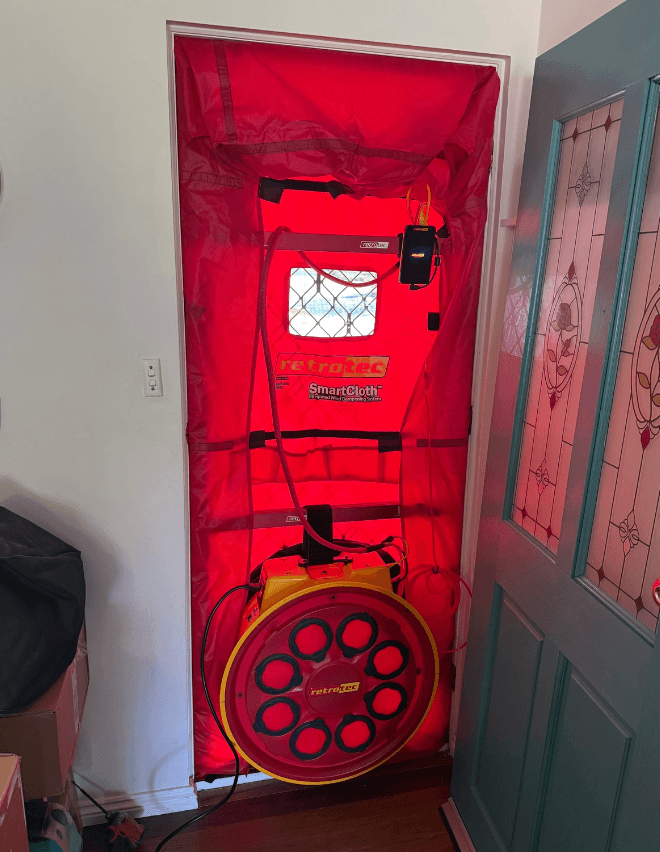
ACH50 isn’t estimated or calculated from plans — it’s measured directly, on site, using a blower door test. A calibrated fan mounted in an adjustable frame fits into an external doorway, connected to a controller/manometer that measures pressure difference and airflow.
- 1The building is prepared: windows and exterior doors closed, interior doors typically left open. See our preparing for a blower door test guide for the complete checklist.
- 2The fan is fitted into an external doorway, sealed around the frame, and connected to the manometer.
- 3The fan gradually increases pressure difference, stepping through a range of pressures and recording the airflow needed to maintain each one.
- 4Software calculates the airflow required to maintain exactly 50 Pascals — often written as Q50 (m³/h or L/s).
- 5Q50 is divided by the building's internal volume to produce ACH50.
- 6Many testers also depressurise the building and use a smoke pencil or thermal camera to physically locate where air is entering.
Pressurisation vs depressurisation. Depressurisation is the more common test direction in Australia, partly because it’s easier to combine with leak-hunting using a smoke pencil. Passive House certification protocols typically require testing in both directions and averaging the result.
Testing at different stages. A blower door test is most useful mid-construction, before wall and ceiling linings go up — the single most valuable time to test, because any leaks found can still be sealed cheaply — and again at practical completion, for a final documented result. Testing twice is standard practice on Passive House and high-performance projects.
4. The ACH50 formula
ACH50 = Q50 ÷ Building Volume
Where Q50 is the airflow rate (m³/h) needed to maintain a 50 Pascal pressure difference, and Building Volume is the total internal conditioned volume in cubic metres.
Worked example: a single-storey home with 220 m² of conditioned floor area and 2.55 m ceilings has an internal volume of approximately 561 m³. If the blower door test measures a Q50 of 3,700 m³/h, then ACH50 = 3,700 ÷ 561 = 6.6 ACH50 — a genuinely typical result for a reasonably well-built, but not high-performance, new Australian home.
Related calculators
5. Typical ACH50 values in Australia
What these numbers feel like in practice
- 20 ACH50 (old weatherboard cottage): noticeable draughts at skirtings and window frames, heaters working hard to keep up.
- 7 ACH50 (illustrative result): a walk-through may reveal no obvious draughts, while a blower door and smoke pencil can still identify leakage at downlights and exhaust fans.
- 3 ACH50 (well-detailed high-performance home): deliberate airtightness strategy paired with MVHR.
- 0.6 ACH50 (certified Passive House): essentially no perceptible air movement through the envelope; every cubic metre of fresh air enters through the ventilation system.
HiPer Haus field note
One documented example: a pre-renovation baseline test on an existing home at Nairne, in the Adelaide Hills, came in at 12.5 ACH50. That measured baseline gave the project a real starting point without relying on an unsupported national average.
Not sure where your home sits?
Book a blower door test →6. What’s a good ACH50 result for your project?
“Good” depends entirely on what you’re trying to achieve. There’s no single pass mark that applies to every home — see our companion article Can you fail a blower door test? for how targets are actually set and enforced.
Testing is usually diagnostic (finding specific leaks) rather than target-driven.
Similar to brick veneer; often leakier due to more panel joints and, in older homes, no sarking or wall wrap.
NCC 2022 does not set a universal ACH50 pass mark; check the approved compliance pathway and project specification.
Requires a defined airtightness strategy from design stage, paired with MVHR.
Mandatory for certification; requires a continuous, designed air barrier.
7. Why lower isn’t always better — without ventilation
An airtight home with no mechanical ventilation is a health and moisture risk — not an achievement. Reducing ACH50 without a corresponding ventilation strategy traps CO₂, moisture, cooking odours, and indoor pollutants inside the building, and can lead to condensation and mould — see airtightness and mould.
Older, leakier homes get a form of accidental “ventilation” through their leaks. As a home gets more airtight, that accidental dilution disappears, and has to be replaced with something intentional — ideally Mechanical Ventilation with Heat Recovery (MVHR), which supplies continuous fresh air without the energy penalty of just opening windows.
This is exactly why NCC 2022 links its mechanical ventilation requirement directly to airtightness performance. Read the full explanation in why airtight homes need ventilation.
8. ACH50 vs other airtightness metrics
ACH50 is the most commonly quoted figure in Australia and in Passive House documentation, but it isn’t the only way airtightness gets expressed:
ACH50 (or n50)
Air changes per hour at 50 Pa, relative to internal volume — Residential testing and Passive House documentation
q50
Airflow at 50 Pa relative to envelope (surface) area, not volume — Common in UK and some European building codes
w50
Airflow at 50 Pa relative to floor area — Occasionally used in commercial building codes
ELA (Effective Leakage Area)
Total leakage as an equivalent single hole size, usually at 4 Pa — More common in North America
9. Common misconceptions about ACH50
“A lower number always means a better-built home.”
Not on its own. A very low ACH50 without matching mechanical ventilation is a liability, not a selling point.
“ACH50 tells you how much air leaks out of my house normally.”
It's a standardised test condition at an artificial pressure. Real-world leakage under everyday conditions is much lower than the ACH50 figure suggests.
“You can estimate ACH50 by feeling for draughts.”
A blower door creates a large, even pressure difference that reveals leaks completely undetectable under normal conditions.
“New homes are automatically airtight because they're new.”
CSIRO's 2024 study found substantial variation between 233 newly built homes. Airtightness must be detailed and then measured.
“ACH50 and insulation (R-value) measure the same thing.”
Insulation slows heat conduction through materials; airtightness stops uncontrolled air movement through gaps. A home can be one without the other.
“Passing a blower door test once means the home stays airtight forever.”
Airtightness can degrade over time as sealants age or gaps open up around penetrations. It's a snapshot, not a permanent guarantee.
10. How ACH50 is used in Australia
NCC 2022 compliance
There is no universal ACH50 pass-or-fail line. H6V3 uses measured air permeability in m³/(h·m²) and applies only when that Verification Method is used. See our NCC guide for the exact distinction.
Passive House certification
ACH50 ≤0.6 is a fixed, non-negotiable requirement under the Passive House Institute's criteria.
Builder specifications and contracts
Increasingly, project specifications nominate a specific ACH50 target as a measurable performance requirement, tested at handover.
Diagnostics on existing homes
For renovations or comfort/mould complaints, a blower door test is used diagnostically to locate leakage paths.
HiPer Haus carries out blower door testing across Adelaide and South Australia for all of these purposes — read more on our blower door testing service page.
Frequently asked questions
What does ACH50 stand for?
Air Changes per Hour at 50 Pascals — a standardised measure of how airtight a building's envelope is, tested with a blower door.
Is a lower ACH50 always better?
Only when paired with adequate mechanical ventilation. A very airtight home without a ventilation system will trap moisture and indoor pollutants.
What ACH50 do I need to pass NCC 2022?
NCC 2022 does not set a universal maximum ACH50 that every home must achieve. H6V3 is an optional building-envelope sealing Verification Method using air permeability in m³/(h·m²), not ACH50, and requires mechanical ventilation when its threshold is met.
What ACH50 is required for Passive House?
0.6 ACH50 or lower, tested in both pressurisation and depressurisation directions and averaged, per Passive House Institute certification criteria.
How is ACH50 different from a "leaky house"?
"Leaky" is a general description; ACH50 is the specific, measured number that quantifies exactly how leaky. Two homes that both feel draughty could have quite different ACH50 results.
Can I calculate my own ACH50 without a blower door test?
No — ACH50 can only be measured with a calibrated blower door test. It cannot be reliably estimated from plans, materials used, or a visual inspection.
Does ACH50 measure my whole house or just one room?
Standard testing treats the whole conditioned volume as a single zone, with internal doors open, giving one ACH50 figure for the entire home.
What's a typical ACH50 for a brick veneer home in Adelaide?
There is no robust national ACH50 benchmark for all existing brick veneer homes. Age, ceiling penetrations, wall linings, windows and alterations can produce very different results, so a blower door test is the reliable way to establish the building's baseline.
Does double glazing improve my ACH50 result?
Only indirectly, and only if the windows are installed and sealed correctly. Double glazing improves thermal performance but doesn't automatically improve airtightness.
Do I need to test twice — during construction and at completion?
It's not mandatory for most projects, but it's strongly recommended, and required for Passive House certification.
What happens if my result is worse than I hoped?
In most cases, specific leaks can be identified and sealed, and the home retested.
Is ACH50 the same everywhere in the world?
The 50 Pascal reference pressure and general test method are internationally consistent, though some countries primarily report q50 rather than ACH50.
Does a bigger house naturally get a worse ACH50?
Not necessarily — ACH50 already accounts for volume. What matters more is the ratio of envelope area and penetrations to volume.
Who carries out blower door testing in Adelaide?
HiPer Haus provides blower door testing across Adelaide, the Adelaide Hills, Barossa, Fleurieu, Mount Gambier, and the Riverland.
Related articles
Had a blower door test and not sure what your number means?
Use our ACH Calculator to see your result in context, or book a blower door test with HiPer Haus to get a documented ACH50 result for your Adelaide or South Australian home.
Written by
Jonathen HindryFounder of HiPer Haus. ATTMA Level 1 Airtightness Tester, Certified Passive House Tradesperson and 25+ year plumber — blower door testing, MVHR design and heat pump hot water across Adelaide and South Australia.
