Blower Door Testing Riverland
Airtightness testing for one of South Australia's hottest regions — extreme summer heat, high cooling loads and persistent dust. Independent ATTMA / ISO 9972 reports across Berri, Renmark, Loxton and Waikerie.
- Hot-climate focus
- Cooling-load driven
- Dust-infiltration aware
- ATTMA Level 1 Airtightness Tester
In extreme heat, the envelope does the heavy lifting
HiPer Haus travels to the Riverland as part of our regular regional service — Berri, Renmark, Loxton, Waikerie and the districts along the river. We are a South Australian company, and the Riverland is a region where airtightness testing has a direct, measurable payoff, because the climate here is genuinely extreme by Australian standards.
The Riverland is one of the hottest parts of the state. Summers are long and dry, and runs of days above 40°C are a normal part of the season rather than an exception. In that environment the building envelope has one overriding job: to keep superheated outside air out and conditioned air in. Every gap works against it — hot air leaks in, cooled air escapes, and the cooling system runs harder and longer to hold the same indoor temperature. A blower door test measures exactly how much of that is happening and where.
Two further local realities shape testing here. Cooling load dominates the energy picture, so reducing air leakage is the most cost-effective way to make a Riverland home both comfortable and affordable to run through summer. And dust is a constant: the dry, often windy conditions and the surrounding agricultural and mallee country carry fine dust that enters a home through the same gaps that leak air, settling on sills and surfaces after every windy day. Sealing the envelope to a tested standard addresses heat, cooling cost and dust at once.
The themes that shape testing here — extreme summer temperatures, cooling loads and dust infiltration — run through the rest of this page.
Stop re-cooling the same hot air
On a 42°C Riverland afternoon, a leaky home is constantly drawing in batches of superheated air while the air it has paid to cool escapes. The cooling system never gets ahead — it is re-cooling fresh hot air all day. This is why two homes of the same size and equipment can have very different summer bills: the difference is often the envelope.
Sealing and testing the envelope removes that load. A blower door test quantifies how much of your cooling is currently leaking away and locates the paths so the fix is targeted rather than guessed.
The same gaps that leak air carry dust
In the Riverland’s dry, windy conditions, fine dust from surrounding farmland and mallee is carried into homes through every unsealed gap — the same leakage paths a blower door test measures. The fine layer that appears on sills and surfaces after a windy day is air leakage made visible.
A tested, sealed envelope keeps that dust outside. The smoke-pencil work during the test shows exactly where the dust — and the hot air with it — is currently getting in.
What a blower door test is — and how it works
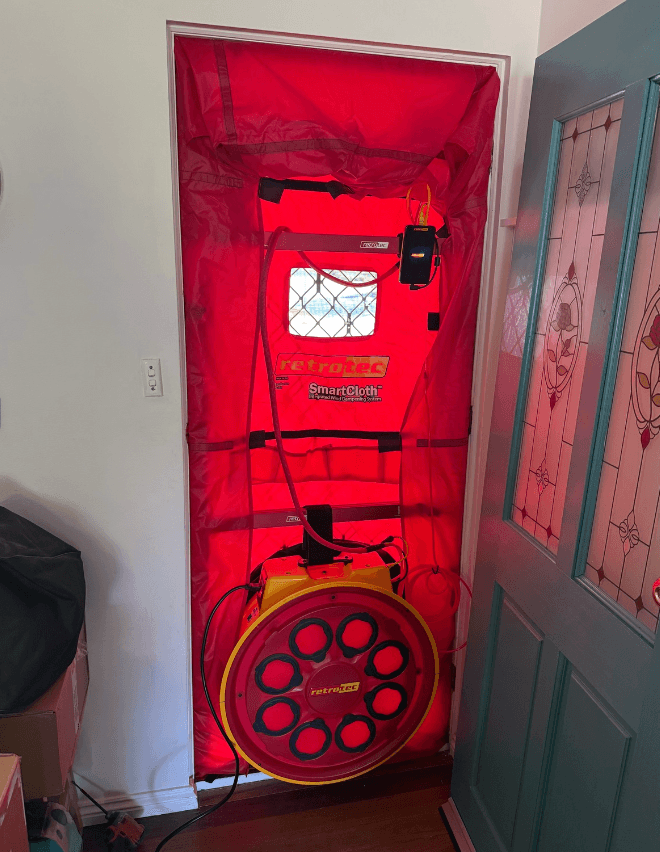
A blower door test measures uncontrolled air leakage through the building envelope. A calibrated fan is fitted into an external doorway and holds the home at a 50 Pascal reference pressure. The airflow required to maintain that pressure is the sum of every gap in the walls, roof and floor — the same gaps that admit hot air and dust in a Riverland summer.
Results are reported as ACH50 and q50. Passive House uses ACH50; NCC compliance often uses q50. Every report includes both with the calibration records.
Why builders use it: in a cooling-dominated climate the air barrier is doing real work, and a test confirms it was built as drawn before the long return trip would be needed for any fix.
Why homeowners use it: it explains why a Riverland home is expensive to cool or never quite gets there in a heatwave, and shows exactly where to seal.
Who needs one: Passive House and EnerPHit projects (mandatory), builders supporting NCC verification, anyone installing MVHR or refrigerated cooling, and owners of existing homes that struggle in the heat.
How testing applies to Riverland projects
New homes
New builds in extreme heat gain the most from a tight envelope. A pre-lining test verifies the air barrier and protects the NCC energy assessment in a region where cooling dominates the load.
Renovations
Older Riverland homes leak hot air and dust through downlights, cooling penetrations and reveals. Testing before and after sealing quantifies what each upgrade delivered against the summer heat.
Passive House
The hot climate makes a high-performance envelope genuinely valuable. We run interim tests and the mandatory final test below 0.6 ACH50, coordinating visits to make the travel efficient.
EnerPHit retrofits
Deep retrofits toward EnerPHit's 1.0 ACH50 need staged testing to find hot-air leaks at the roof, penetrations and openings before they are concealed again.
High-performance homes
Homes pairing an airtightness target with refrigerated cooling or designed ventilation benefit from measured verification. A test confirms the achieved envelope result for the project team.
Volume builders & architects
Builders use a test for NCC support and delivered-quality evidence; architects use an airtightness schematic plus a verifying test to hold hot-climate detailing across trades on a distant site.
Where Riverland homes commonly leak
The region’s heat, cooling systems and dust create a characteristic set of leakage paths. These are the details that matter most in a Riverland summer.
Recessed downlights into a hot roof space
A Riverland roof void can exceed 60°C in summer, and each downlight is an open hole connecting that superheated space to the rooms below. In single-storey homes with large ceiling areas, downlights are often the biggest single hot-air leak.
Evaporative cooling penetrations
Ducted evaporative units leave large roof penetrations and ceiling outlets. When a home shifts toward refrigerated cooling, unused or poorly sealed evaporative ducting becomes a major path for hot air and dust into the home.
Service penetrations
Plumbing, electrical and air-conditioning penetrations through walls and ceilings are frequently left unsealed above the lining, admitting hot air and fine dust straight into the building.
Door and window reveals
On a hot, windy day the reveals, tracks and seals of doors and windows leak hot, dusty air. Sliding doors with worn seals are a common and visible culprit.
Ceiling hatches
A manhole hatch into a 60°C roof void is an uninsulated, usually unsealed gap that lets heat pour down into the living space — a small detail with a real effect in extreme heat.
Exhaust fans without backdraught seals
Bathroom and kitchen exhausts that vent to the roof or eave without a seal leave a permanent open path; in summer they let hot roof-space air and dust drift back into the home.
For more on how kitchen extraction behaves once a home is sealed, see our Range Hood Makeup Air Calculator.
Need a price for your Riverland project?
Use the tool below for an indicative cost in under a minute. Because the Riverland is a longer regional run, grouping tests keeps travel efficient — final pricing is confirmed in your quote.
Indicative testing price
$880
incl GST · indicative estimate
Includes the calibrated test, on-site leak investigation, measured results and written report.
Check availability for your project
Send us the essentials and we’ll confirm the test scope, price and available dates.
Testing services available in the Riverland
Pre-lining testing
Mid-construction diagnostic before plasterboard — vital when rectification before the return trip is far cheaper.
Final testing
Completion test documenting ACH50 / q50 for handover, NCC or certification.
ATTMA testing
Reports to ATTMA TSL1 methodology and format.
ISO 9972 testing
Testing to the ISO 9972 international standard.
Leakage investigation
Smoke-pencil diagnostics targeting hot-air and dust leakage paths.
Smoke testing
Visual confirmation of air movement at junctions and penetrations.
Thermal imaging
Used on hot days to reveal where heat is entering the building fabric.
Compliance testing
Documented air-permeability results to support H6V3 or another nominated project pathway.
Why Riverland builders and homeowners choose HiPer Haus
ATTMA Level 1 Airtightness Tester
Accredited testing and reporting to ATTMA TSL1 / ISO 9972 with full calibration records.
Passive House experience
Certified Passive House tradesperson experience for the region's high-performance builds.
Practical construction knowledge
We understand how heat, cooling systems and dust drive leakage in this climate.
Detailed reporting
Plain-English findings plus a documented report formatted for your pathway.
South Australian company
A local SA business that travels to the Riverland regularly.
Independent testing
No product agenda — just the measured result and honest next steps.
Builder friendly
We coordinate visits around build programmes to make regional travel efficient.
Homeowner friendly
We explain what the result means for cooling cost and comfort in plain terms.
Across the Riverland
From Renmark and Berri to Loxton and Waikerie, we test wherever the Riverland builds. We regularly support airtightness testing for projects across the region, including new builds, renovations and high-performance homes, and grouping several tests on one regional run is the most efficient way to bring testing to the region. Neighbouring areas are covered on our Adelaide and Barossa pages.
Riverland blower door testing — frequently asked questions
Learn more about airtightness
Blower Door Testing — main service
Pricing, methodology, what's included and the instant quote tool.
Airtightness explained
Why uncontrolled air leakage drives cooling load and comfort problems.
What is Passive House?
The standard behind the 0.6 ACH50 target — valuable in extreme heat.
High-performance homes
What makes a home perform where cooling dominates the energy load.
Range hood makeup air calculator
How kitchen extraction behaves once the envelope is sealed.
NCC 2022 for SA homes
What the energy and ventilation provisions mean for hot-climate SA builds.
Blower door testing in other South Australian regions
We test right across the state. If your project sits outside this region, these guides cover the local housing styles, climate and common leakage points in each area.
Adelaide
Metro new builds, custom homes and volume builders.
View Adelaide →Adelaide Hills
Cold winters, bushfire construction and condensation risk.
View Adelaide Hills →Barossa Valley
Custom homes, straw bale and high thermal mass.
View Barossa Valley →Fleurieu Peninsula
Coastal homes, sea winds and salt-air durability.
View Fleurieu Peninsula →Mount Gambier
Limestone homes, a windy climate and colder temperatures.
View Mount Gambier →Talk to HiPer Haus about testing in the Riverland
Tell us about your Riverland build, hot-climate renovation or Passive House project and we’ll coordinate an efficient regional visit and confirm pricing.