Will Your Range Hood Suck Air Through Your Walls?
Powerful range hoods and airtight homes don't automatically get along. This calculator estimates the negative pressure your hood could create — and the makeup air you need to fix it.
What is makeup air?
Makeup air is the replacement air a home needs while a range hood is running. A hood doesn’t destroy air — every cubic metre it blows outside has to come back in from somewhere.
In a leaky older home, that air seeps back in through gaps and cracks and nobody notices. In a modern airtight home there are far fewer gaps, so a powerful hood pulls the whole house into negative pressure — dragging air in through exhaust fans, downlights and door seals, and in the worst case back down fireplaces and flues.
“Makeup air” simply means giving that replacement air a deliberate, controlled way in, instead of letting the house claw it back through every weak point. Below you can see when it’s needed, estimate it for your own home, and see what a good solution looks like.
When is makeup air required?
The honest answer is that it depends on the combination of hood size and how airtight your home is — not the hood alone. A quick way to place your own home:
| Home | Likely result | Typical approach |
|---|---|---|
| 1990s brick veneer | Usually low risk | Existing leakage is usually enough |
| New NCC home | Moderate risk | A dedicated makeup-air path may help |
| Passive House | Makeup air almost always required | Sealing shutters with an interlocked makeup-air fan |
There is no single Australian airflow threshold that automatically requires makeup air in every situation. The risk depends on the combination of extraction rate, house volume, airtightness (your ACH50 result) and the presence of combustion appliances. Use the calculator below with your own numbers rather than relying on the hood’s rating alone.
NCC 2022 and range hoods
Since October 2024, new homes in South Australia have been required to comply with the NCC 2022 condensation management provisions. One of the key changes is that kitchen range hoods must discharge outdoors rather than simply recirculating air within the home.
- ✓Range hoods must discharge outdoors, not recirculate.
- ✓This improves removal of moisture, grease and cooking pollutants.
- ✓It also means more air leaves the building — which matters more in airtight homes.
Range hood makeup air calculator
Enter your range hood’s extraction rate, your home’s size and airtightness. The defaults represent a 250 m² home at 3 ACH50 with a 900 m³/h hood — adjust them to match your project.
Range Hood Makeup Air Calculator
Estimate the negative pressure your range hood could create — and how much makeup air your home actually needs.
Important: most people cook on medium settings most of the time. This calculator uses the maximum rated airflow on purpose — makeup-air systems and negative-pressure risk have to be sized for the highest extraction the hood can produce, because sooner or later someone presses the boost button.
Estimated negative pressure
14.4 Pa
Running this hood pulls a 799 m³/h shortfall through the building — about 8.9× more air than your home’s natural leakage can replace.
Low
< 3 Pa
Moderate
3–5 Pa
High
5–10 Pa
Severe
> 10 Pa
This is an estimate based on your blower door result and house size. The actual pressure depends on leakage distribution, duct resistance, other exhaust fans and weather. A blower door test gives the most accurate assessment.
At full speed, your 900 m³/h range hood removes the entire air volume of your home every 45 minutes.
That’s the same amount of air as running 18 bathroom exhaust fans at once.Assuming ~50 m³/h per bathroom fan.
Recommended makeup air
799 m³/h (222 L/s)
A dedicated makeup-air inlet — a sealing insulated shutter with a small fan interlocked to the hood — is recommended, so replacement air is supplied while the hood runs and the home reseals the rest of the time.
Window opening equivalent
A visual guide to how big an opening your makeup air would need — not a precise window-sizing tool.
As a reference, at 10 Pa your home would need an open area of about 0.091 m² to replace the missing air — roughly a 301 × 301 mm opening, or a 600 mm wide window opened about 151 mm.
open gap ≈ 151 mm
906
cm²
Free area
301
mm
Square side
151
mm gap
600 mm window
| Deficit | Square opening at 10 Pa | 600 mm window opened |
|---|---|---|
| 100 m³/h | 106 × 106 mm | 19 mm |
| 300 m³/h | 184 × 184 mm | 57 mm |
| 600 m³/h | 261 × 261 mm | 113 mm |
| 900 m³/h | 319 × 319 mm | 170 mm |
| 1,200 m³/h | 369 × 369 mm | 227 mm |
This is not a precise window-sizing calculation. Real airflow depends on wind, screen resistance, opening shape, insect mesh, louvres and pressure difference. It is a visual guide to the scale of replacement air required. We use 10 Pa as a visual reference point — actual airflow can be higher or lower depending on wind, window type, insect screens and leakage paths.
Do you have (or plan to have) MVHR?
If so, simply opening a window is usually not the best long-term solution. MVHR systems are designed to provide controlled, balanced ventilation, and opening windows can undermine that balance while reducing the benefits of an airtight home.
A dedicated makeup-air inlet — a sealing insulated shutter with a small fan interlocked to the range hood — supplies replacement air only when the hood is operating, then reseals when it’s not. This helps maintain ventilation performance while preserving the home’s airtightness. Explore makeup-air solutions for airtight homes →
Your home may require a dedicated makeup-air strategy.
Large range hoods and airtight homes can be a challenging combination. A blower door test can identify whether your home is likely to experience significant negative pressure and help determine the most appropriate solution.
Book a blower door test & ventilation assessmentNegative pressure estimated from the envelope leakage curve (Q = C·ΔP^0.65) with natural infiltration approximated as ACH50 ÷ 20. This is an educational estimate, not a mechanical-ventilation design — makeup-air and combustion-safety decisions should be verified by a qualified professional.
What does a makeup air system look like?
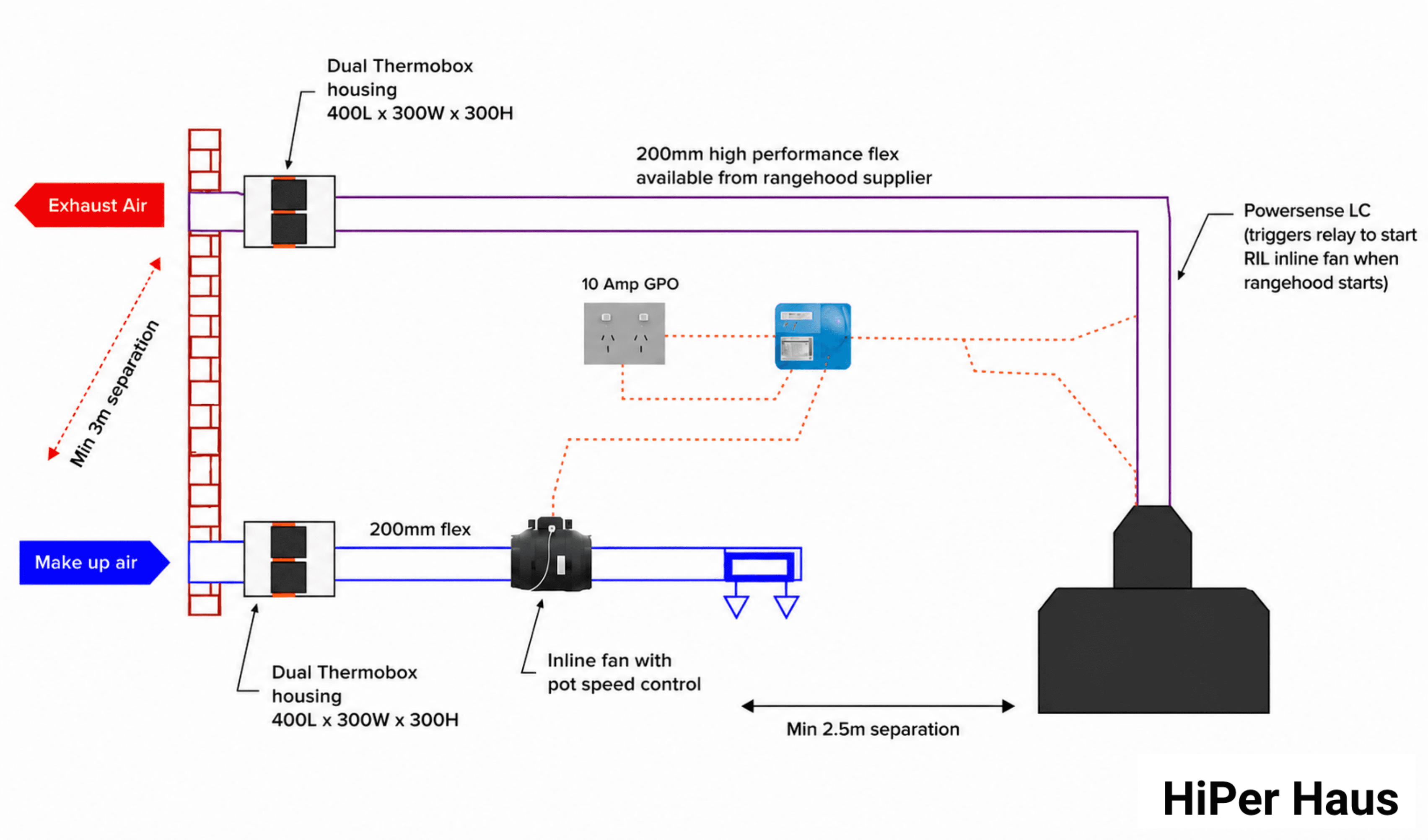
A makeup-air system gives the air your hood extracts a deliberate way back in — a dedicated duct from outside, usually wired to the range hood so it only opens while the hood runs and stays sealed the rest of the time.
Why are the intake and exhaust separated?
The makeup-air inlet and the range hood exhaust are kept well apart so that cooking odours, moisture, grease particles and other contaminants aren’t simply drawn straight back into the replacement air. Good separation keeps the incoming air clean and lets both the inlet and the exhaust work as intended.
How the system works
- 1The range hood starts and begins exhausting air from the home.
- 2A power-sensing relay automatically starts the makeup-air fan.
- 3Fresh outdoor air enters through a dedicated makeup-air inlet.
- 4Sealing insulated shutters such as the Naber Thermobox open under airflow.
- 5When cooking stops, the fan switches off and both shutters reseal — helping maintain the airtightness and thermal performance of the building envelope.
Why can’t the MVHR system just replace the air?
A typical MVHR system might move 150–300 m³/h of air through the home. A large range hood can remove 900–1,200 m³/h on its highest setting — three to eight times more air than the ventilation system is designed to supply. That’s why a large hood in an airtight home needs a dedicated makeup-air strategy of its own, even when MVHR is installed.
The shutter is the part that makes or breaks airtightness
Where the duct passes through the wall there’s a shutter that opens when the hood runs and should close the outlet when it stops. On an airtight home, the type you use matters far more than most people expect.
Standard backdraft flap — leaks
A simple spring- or gravity-flap shutter never closes fully. Air, draughts and insects leak through the wall outlet all year, it insulates poorly — so heat escapes through the duct whenever the hood is off — and it pushes up your blower door result. A cheap backdraft flap can quietly undo the airtightness you paid for.
Sealing insulated shutter — e.g. Naber Thermobox
A purpose-built sealing shutter closes airtight when the hood is off. The Naber Thermobox is a purely mechanical backpressure shutter (no electricity): magnet-sealed flaps form insulating air chambers, so it’s blower-door tested, insulates far better than a standard wall outlet, and doesn’t rattle in wind — keeping the penetration from becoming a permanent leak in your envelope.
That sealing shutter sits at the heart of how we design makeup air. On an airtight or Passive House project we typically fit a Thermobox (or similar sealing insulated shutter) on both the exhaust outlet and a dedicated makeup-air inlet, then add a small inline fan on the inlet duct. A power-sensing relay starts that fan automatically whenever the range hood runs, so fresh replacement air is pushed in to match what the hood extracts. When cooking stops, the fan switches off and both shutters reseal — so the home holds its airtightness instead of leaking through two open holes in the wall.
How we typically design makeup air
- A dedicated makeup-air inlet ducted to outside, separate from the hood’s exhaust
- Sealing insulated shutters (such as the Naber Thermobox) on both the exhaust outlet and the makeup-air inlet
- A small inline fan on the makeup-air duct, started by a power-sensing relay whenever the hood runs
- Custom solutions for very large or commercial-style range hoods
Notice there’s no motorised makeup-air damper in this approach — the sealing shutters handle airtightness mechanically, and the interlocked fan does the air-moving. Fewer powered moving parts, and the envelope stays sealed whenever the kitchen isn’t in use.
How the calculation works
A range hood doesn’t consume air — it relocates it outside. So the real question is: can your home supply replacement air as fast as the hood removes it? The calculator compares two numbers.
The method
Volume = floor area × ceiling height
Natural infiltration = (ACH50 ÷ 20) × volume
Air deficit = hood airflow − natural infiltration
Example: 250 m² home, 2.7 m ceilings, 3 ACH50, 900 m³/h hood
Volume = 675 m³ → infiltration = 0.15 × 675 = 101 m³/h → deficit = 900 − 101 = 799 m³/h
The ACH50 ÷ 20 step converts your blower door result (measured at the elevated 50 Pa test pressure) into a rough estimate of everyday natural air changes. It’s a widely used rule of thumb that makes the numbers easy to picture:
| ACH50 | Approx. natural ACH | What it means for makeup air |
|---|---|---|
| 10 | 0.5 | Leaky — supplies a lot of makeup air on its own, but at the cost of comfort and energy |
| 5 | 0.25 | Average new build — partial self-supply, large hoods still create a deficit |
| 3 | 0.15 | Airtight — little natural supply, dedicated makeup air usually needed |
| 1 | 0.05 | Very airtight — essentially no self-supply, makeup air is essential |
The part that’s actually dangerous: backdraft
Negative pressure isn’t just an efficiency nuisance. When a powerful hood depressurises a home that has no makeup air, the path of least resistance for replacement air can be down a flue. In an open-flued wood heater, fireplace, gas heater or gas hot water unit, that reverses the normal upward draught and can pull combustion gases — including carbon monoxide — back into the living space.
Does your home have any of these combustion or flued appliances?
If so, negative pressure can reverse the airflow in these appliances, potentially drawing combustion products — including carbon monoxide — back into the home. The larger the air deficit your range hood creates, the more significant this risk becomes.
This is a safety issue, not a comfort one. A powerful extracting range hood should never share a home with an open-flued combustion appliance unless a verified makeup-air solution keeps the house out of significant negative pressure. If you have a wood heater, open fireplace or any gas appliance with a flue, have the combination assessed by a qualified professional before relying on the hood.
Why Passive Houses often avoid large exhaust range hoods
The tighter the building, the bigger this problem gets — which is why Passive House and high-performance kitchens approach extraction differently:
They are intentionally airtight: Passive House homes are built to be extremely airtight by design, so there is almost no natural leakage available to supply makeup air to a large hood.
A big hood can overwhelm natural leakage: A 1,200 m³/h hood can easily remove air faster than an airtight envelope can replace it, pulling the house into strong negative pressure, interfering with MVHR balance and risking backdraft.
Most pair the hood with interlocked makeup air: Where an extracting hood is used, a dedicated makeup-air inlet with sealing insulated shutters and a fan interlocked to the hood supplies replacement air on demand — then reseals when cooking stops, so airtightness isn't compromised.
There is no universal answer — the right balance of hood size, makeup air and MVHR depends on the project. This is exactly the kind of trade-off HiPer Haus helps resolve at design stage.
Important
This calculator provides an estimate based on your home’s size and airtightness. Actual pressures can vary depending on leakage distribution, wind conditions, duct resistance, other exhaust systems and how the building is operated. A blower door test is the most accurate way to understand how airtight your home really is and whether a dedicated makeup-air strategy should be considered.
Blower Door Testing
Measure your home's airtightness — the number this calculator depends on
ACH50 Calculator
Is your blower door result good? Calculate ACH50 and compare it to the benchmarks
How Big Is the Hole in Your House?
Picture your air leakage as a single hole in the building fabric
MVHR Systems
Balanced mechanical ventilation with heat recovery, designed for airtight homes
What Is MVHR?
How mechanical ventilation with heat recovery works in an airtight home
Range Hoods in Airtight Homes
The full guide to extraction and makeup air in tight buildings
Frequently asked questions
What is makeup air for a range hood?
Makeup air is replacement air deliberately brought into the home to balance what a range hood extracts. A range hood doesn't destroy air — every cubic metre it removes has to be replaced from somewhere. In a leaky home that air seeps in through cracks and gaps. In an airtight home there is nowhere for it to come from, so the hood pulls the house into negative pressure unless a dedicated makeup-air path is provided.
Do I need makeup air for my range hood?
It depends on how powerful the hood is and how airtight your home is. A low-powered hood in a leaky home may need none. A 600–1,200 m³/h extracting hood in an airtight home (below roughly 5 ACH50) will usually create enough negative pressure to need a dedicated makeup-air inlet — typically with sealing insulated shutters and a small fan interlocked to the hood. The calculator on this page estimates the air deficit so you can see whether your specific combination is a problem.
What kind of damper or shutter should a makeup-air system use?
On an airtight home, every duct that penetrates the envelope needs a shutter that seals when the hood is off. A purpose-built backpressure shutter such as the Naber Thermobox is purely mechanical (no electricity) — its magnet-sealed flaps form insulating air chambers and it is blower-door tested, so the wall outlet doesn't leak or lose heat. A standard spring or gravity backdraft flap never seals fully, so it leaks air all year, loses heat and drives up your blower door result. On the supply side we fit the same kind of sealing shutter on a dedicated makeup-air inlet, with a small inline fan interlocked to the hood that pushes replacement air in while it runs.
Can a range hood cause backdraft in a wood heater or gas appliance?
Yes. If a powerful range hood depressurises the house and there is no makeup air, the negative pressure can reverse the airflow in an open-flued appliance — a wood heater, open fireplace, gas heater or gas hot water unit — and draw combustion products, including carbon monoxide, back into the living space. This is a recognised safety hazard. Never run a powerful extracting hood alongside an open-flued appliance without a verified makeup-air solution, and have the combination assessed by a qualified professional.
How is the air deficit calculated?
First the building volume is found from floor area × ceiling height. The ACH50 blower door result is converted to an approximate natural air-change rate using the common rule of thumb of dividing by 20. Multiplying that natural rate by the volume gives how much air the home can passively draw in per hour. The deficit is the range hood's extraction rate minus that natural infiltration. For example, a 675 m³ home at 3 ACH50 has natural infiltration of about 101 m³/h; a 900 m³/h hood leaves a deficit of roughly 799 m³/h.
Why do Passive Houses avoid large range hoods?
Passive House and other very airtight buildings have almost no natural infiltration, so a large extracting range hood would severely depressurise them. The usual answer is an extracting hood paired with a dedicated, interlocked makeup-air supply that opens only while the hood runs. The principle is simple: in an airtight home, any large exhaust appliance has to be designed in as part of the ventilation strategy, not bolted on afterwards.
A range hood is a ventilation appliance, not just an accessory.
In a leaky home you can get away with ignoring makeup air. In an airtight one you can’t — the physics won’t allow it. Plan extraction, makeup air and combustion safety together, and the kitchen works the way it should without fighting the building.
Planning an airtight home?
HiPer Haus designs MVHR systems, range hood makeup-air solutions, airtightness strategies and blower door testing across Adelaide and South Australia — so your kitchen extraction and your building envelope are designed to work together.
Written by
Jonathen HindryFounder of HiPer Haus. ATTMA Level 1 Airtightness Tester, Certified Passive House Tradesperson and 25+ year plumber — blower door testing, MVHR design and heat pump hot water across Adelaide and South Australia.
