Why Airtight Homes Need Ventilation
Airtightness and ventilation aren't competing goals — they're two halves of the same job.
It’s a question we hear constantly from homeowners, builders and designers: if we’re spending money to make a home airtight, doesn’t that mean it can’t “breathe”? The short answer is that airtight homes breathe better than leaky ones — but only if they’re paired with proper ventilation.
By Jonathen Hindry · Published 2 July 2026 · Updated 11 September 2026 · 15 min read
Key takeaways
- Older, leakier homes get accidental, uncontrolled ventilation through gaps. As a home becomes more airtight, that accidental air exchange disappears — and needs to be deliberately replaced.
- Without replacement ventilation, an airtight home accumulates CO₂, moisture and pollutants, and is at higher risk of condensation and mould.
- Opening windows is not a reliable substitute for mechanical ventilation — it's weather-dependent and depends entirely on occupant behaviour.
- MVHR (Mechanical Ventilation with Heat Recovery) is the recommended solution: continuous fresh air while recovering up to around 90% of the heat that would otherwise be lost.
- NCC 2022 formally recognises this within H6V3 — where that optional Verification Method is used and its air-permeability threshold is met, mechanical ventilation must meet a calculated minimum airflow rate.
Jump to a section
1. The core problem: airtightness removes accidental ventilation
Every existing home has some degree of uncontrolled air leakage. In a leakier home, that movement may be dismissed as a minor annoyance — but it also exchanges indoor and outdoor air unpredictably, without providing reliable ventilation where and when it is needed. See what ACH50 measures.
As a home becomes more airtight — through better window seals, taped membranes, sealed penetrations (see what makes a house airtight) — that accidental exchange shrinks. At Passive House levels (≤0.6 ACH50), it’s almost eliminated entirely. Removing accidental leakage is good — it saves energy and improves comfort — but only if it’s replaced with a designed, controlled ventilation system.
This is not unique to Passive House
Any home built or renovated with modern sealing practices — quality double-glazed windows, sarking, taped joints — has reduced its accidental ventilation, whether or not “airtightness” was ever a stated design goal. Ventilation needs to be considered any time a home is sealed up better than it used to be.
HiPer Haus field note
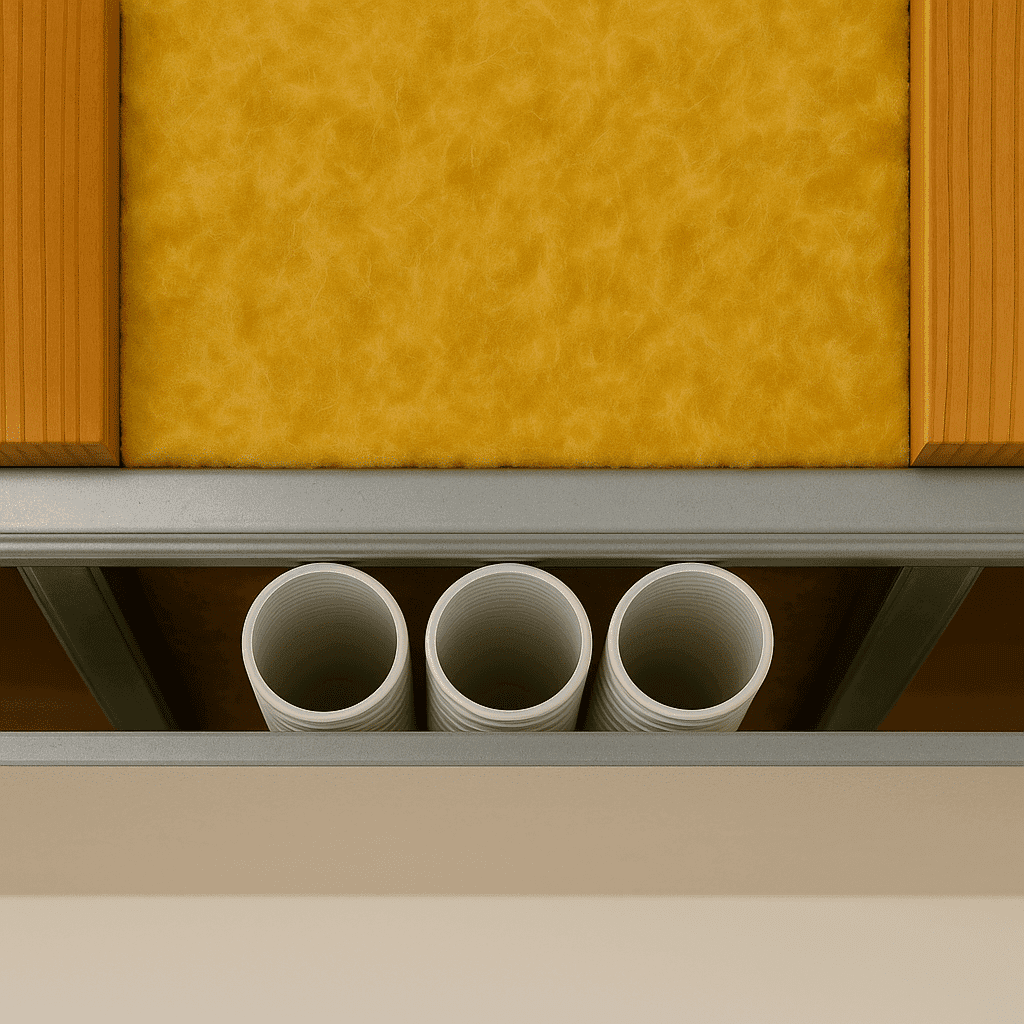
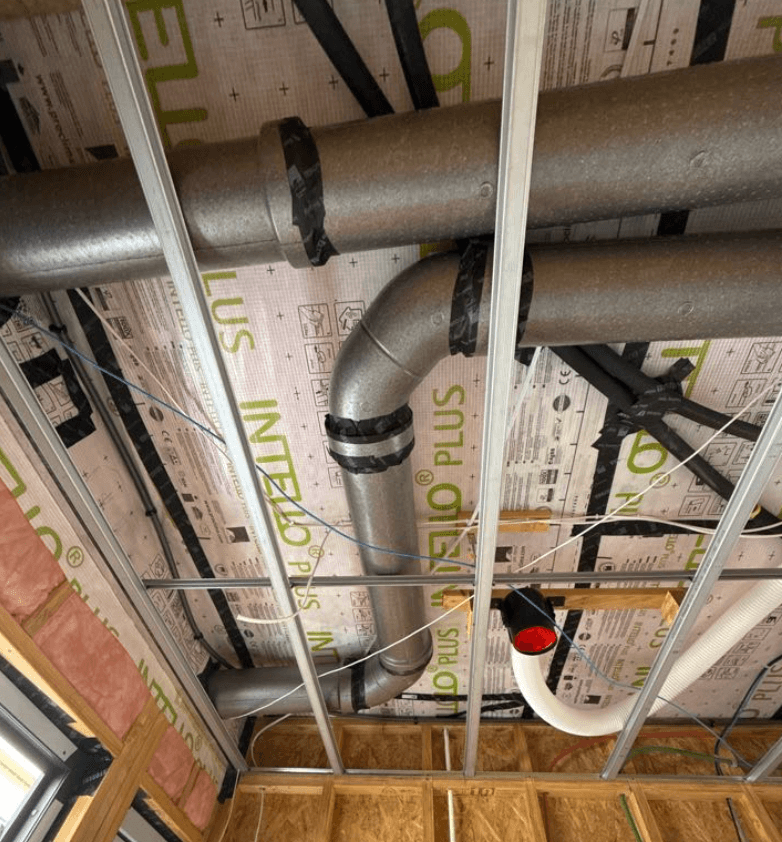
On a project at Wynn Vale with Enduro Builders, MVHR ductwork (Zehnder ComfoAir Q350 with ComfoTube) was run within a Pro Clima Intello airtight dropped ceiling — keeping the entire duct run inside the thermal and air barrier, rather than routing it through unconditioned roof space. Coordinating the ventilation design with the airtightness layer from the start avoided penetrating the air barrier at all.
2. Indoor air quality basics — what builds up in a sealed home
Carbon dioxide (CO₂). Every person exhales CO₂ continuously. Elevated indoor CO₂ is widely used as a practical proxy for “how much fresh air is this room getting”:
See our Bedroom CO₂ Calculator to estimate overnight build-up for a specific bedroom, and our article on poor sleep and CO₂ for the sleep-quality angle.
Moisture and humidity, odours and combustion by-products all accumulate the same way without adequate ventilation. Gas cooktops and unflued heaters need particular attention — see range hoods in airtight homes and the Range Hood Makeup Air Calculator.
Related calculators
3. Moisture, humidity and condensation
Warm air holds more moisture than cold air, so when moist indoor air meets a cold surface, it cools, its capacity to hold moisture drops, and the excess condenses. See what is relative humidity for the underlying physics.
This is the single most common complaint HiPer Haus hears about new, airtight-ish homes: “the house feels stuffy and we’re getting mould on the bedroom window, but the house is only a year old.” In almost every case, the airtightness isn’t the problem — the missing or undersized ventilation is. See our full article on airtightness and mould.
4. Why opening windows isn’t a reliable strategy
“Just open a window” works — while the window is open. The problem is reliability: weather dependence (Adelaide winters mean losing the heat you’ve paid to generate exactly when you most need it), occupant dependence (windows are usually shut overnight, exactly when bedroom CO₂ and humidity build up most), security and noise, and no heat recovery.
Window opening still has a place — rapid purge ventilation after cooking, for example — but it isn’t a substitute for a designed ventilation system in an airtight home.
5. Natural ventilation vs mechanical ventilation
Natural (windows, gaps)
- Weather and occupant dependent
- Large heat loss when windows are open
- No control — can’t target specific rooms
- Poor fit for airtight homes
Mechanical
- Continuous, runs regardless of weather or habits
- Heat recovery (MVHR) reclaims most of the energy
- Airflow can be designed and balanced room by room
- Essential for airtight homes
6. Mechanical ventilation options compared
Exhaust-only
Extracts air from wet areas; replacement air drawn in through gaps or dedicated inlets
No heat recovery; relies on the building being somewhat leaky, which conflicts with airtightness goals
Supply-only (positive pressure)
Fresh, filtered air supplied under slight positive pressure, pushing stale air out
No heat recovery; can push moist air into cavities in a leaky building if not carefully designed
Balanced (no heat recovery)
Separate matched supply and extract fans
Still loses all the heating/cooling energy in the exhausted air
MVHR (recommended)
Balanced supply and extract routed through a heat exchanger, transferring heat between outgoing and incoming air
Higher upfront cost and ducting requirements; needs correct design and commissioning
For airtight Australian homes, MVHR is the system HiPer Haus recommends and installs — see what is MVHR and our MVHR service page.
7. Heat recovery — fresh air without the energy penalty
An MVHR unit draws stale, humid air from bathrooms, kitchens and utility areas, and fresh air from outside, and passes both streams through a heat exchanger core — without mixing them. Well-designed and commissioned MVHR systems commonly recover in the order of 80–90% of the energy that would otherwise be lost.
Reviewing a ventilation strategy for an airtight home?
View our MVHR service →8. Airtightness and ventilation as a package
NCC 2022 H6V3 requires that, where this optional Verification Method is used and air permeability is verified at not more than 5 m³/(h·m²) at 50 Pa, the home must have mechanical ventilation providing at least a calculated minimum airflow rate. Air permeability and ACH50 are different measurements:
Airflow (L/s) = 0.05 × Floor Area (m²) + 3.5 × (Bedrooms + 1)
See our full NCC 2022 ventilation guide for how this applies in South Australia (provisions commencing 1 October 2024). The practical implication: airtightness and ventilation should be designed together, from the start of a project.
9. Real-world examples
Typical volume-built home
Often 8–15 ACH50, with ventilation limited to openings and local exhaust fans. Its approved NCC pathway—not this ACH50 band—determines the regulatory requirements.
High-performance custom home
≤3 ACH50, MVHR installed. Airtightness strategy and MVHR design happen together from the design stage.
Certified Passive House
≤0.6 ACH50, MVHR mandatory — a core part of the standard itself.
Existing home mid-retrofit
Adding insulation and sealing gaps without reviewing ventilation can inadvertently create moisture and mould conditions.
Frequently asked questions
Do all airtight homes need MVHR?
Not strictly by law in every case. MVHR is a performance-led solution for homes designed to limit uncontrolled leakage. Under NCC 2022, the optional H6V3 Verification Method requires mechanical ventilation where verified air permeability is not more than 5 m³/(h·m²) at 50 Pa; this is not a universal 5 ACH50 rule.
Can I just rely on bathroom and kitchen exhaust fans?
Exhaust fans help remove moisture at the point of generation but don't provide continuous whole-of-home fresh air or heat recovery.
Won't an airtight house feel stuffy?
Only if ventilation hasn't been properly designed. A well-ventilated airtight home typically has fresher air than an average leaky home.
Is opening windows for 10 minutes a day enough?
It helps but isn't equivalent to continuous mechanical ventilation, and doesn't address overnight CO₂ and humidity build-up.
How much does MVHR cost to run?
Running costs are mainly fan electricity plus a modest heating/cooling top-up, since up to around 90% of heat is recovered.
Do I need MVHR in an existing non-airtight home?
It's most valuable in airtight homes but can still improve air quality in leakier existing homes, especially alongside sealing improvements.
What's the difference between ventilation and air conditioning?
Air conditioning conditions largely recirculated air; ventilation specifically exchanges indoor air for fresh outdoor air.
Does NCC 2022 require MVHR specifically?
No. Where NCC 2022 H6V3 applies and its air-permeability threshold is met, it requires mechanical ventilation meeting a minimum calculated airflow rate without mandating a specific technology. This is not a universal 5 ACH50 rule.
How is ventilation different in a bedroom vs a living area?
Bedrooms typically need dedicated fresh air supply due to long overnight occupancy with doors often closed.
Can too much ventilation be a problem?
Over-ventilation wastes energy and can dry indoor air excessively, which is why systems are designed to a calculated airflow rate.
Does ventilation help with more than just mould?
Yes, it also affects CO₂ levels, odour and VOC removal, and general comfort.
What system does HiPer Haus recommend for South Australian homes?
For airtight and high-performance homes, HiPer Haus specifies and installs MVHR systems designed for the specific home, occupancy and climate.
Related articles
Planning or reviewing a ventilation strategy?
Talk to HiPer Haus about MVHR design tailored to your home and climate.
Written by
Jonathen HindryFounder of HiPer Haus. ATTMA Level 1 Airtightness Tester, Certified Passive House Tradesperson and 25+ year plumber — blower door testing, MVHR design and heat pump hot water across Adelaide and South Australia.
