10 Air Sealing Details That Are Easy During Construction (But Expensive to Fix Later)
Most air leaks aren't one big hole — they're hundreds of small gaps left behind as different trades move through the house. Here's what to seal, and when, while it's still cheap.
By Jonathen Hindry · Published 2 July 2026 · Updated 11 September 2026 · 14 min read
Most air leaks aren’t caused by one big hole. They’re caused by hundreds of tiny gaps left behind as different trades work through the house — a 10 mm gap around a pipe, a few millimetres around a cable, a top plate that never got taped, a plumbing penetration forgotten before plaster.
Individually, they’re insignificant. Together, they can be equivalent to leaving a window permanently open, year-round.
This isn’t a products article. The tapes, grommets and sealants mentioned below are examples, not the point. The point is the details — the specific places in a build where thirty seconds of attention during framing saves hours of remediation, or a permanently leaky house, later on.
Why timing matters more than the products
The biggest mistake isn’t forgetting to seal things. It’s waiting until the house is finished.
Once plasterboard is installed, many of these leaks become difficult or impossible to access without cutting into a lined wall. During framing, before insulation and linings go in, the same detail often takes less than a minute. The window for cheap, effective air sealing is short — and it closes the day the lining crew starts.
The 10 details
1. Service penetrations
Every service that crosses the airtightness layer leaves a hole that needs to be deliberately closed, not just filled around. That includes:
The fastest, most repeatable method is a purpose-made grommet rather than sealant applied by hand around every pipe and cable — an EPDM pipe grommet (Pro Clima Roflex is a common example) stretches around the pipe and seals to the membrane or frame, and a cable grommet (Pro Clima Kaflex is another) does the same for bundles of cables. Airtight sealant still has a place for one-off or irregular penetrations where a grommet doesn’t fit.
The trade sequencing matters here: a plumbing or electrical penetration that’s perfect the day it’s roughed in is easy to forget once three other trades have worked past it. Sealing at first fix — not waiting for a final walkthrough — is what actually gets it done.
2. Top plates
Top plates are one of the biggest leakage paths in a typical home. Every stud bay has a joint at the top plate, and it’s also where most services travel up into the roof space — so it collects joints, penetrations and cracks all in one continuous line.
Seal, along the full length of every top plate:
Joints between plate sections: Every join is a straight-line gap running the depth of the wall.
Service penetrations: Cables and pipes rising into the roof space each need a grommet or sealant bead.
Cracks and gaps from timber movement: Seasoning timber opens small cracks that widen over time if left unsealed.
Junctions with membranes: Where a wall or ceiling membrane meets the plate, the tape or seal needs to be continuous, not stopped short.
This is squarely a before-plaster job. Once the ceiling is lined, sealing a top plate means removing plasterboard to get at it.
3. Bottom plates
The bottom plate has to be sealed before skirting goes on — after that, the junction is hidden and effectively unfixable without removing trim.
This detail varies depending on what the plate sits on:
Concrete slabs
A continuous sealant or gasket bead between the plate and slab closes the most common gap in slab-on-ground construction.
Uneven slabs
A compressible gasket accommodates the small dips and high spots a sealant bead alone can't bridge.
Timber floors
Joints between the plate and flooring, and around any penetrations through the floor, need the same attention as a slab junction.
Sealant or a compressible gasket both work — the important part is that the junction is continuous around the entire perimeter, not just the sections that are easy to reach.
4. Windows and doors
This is one of the most common misunderstandings on site: expanding foam is not an air seal. It’s a gap-filling insulation product. It isn’t tested or rated as an air barrier, it can shrink over time, and it doesn’t reliably bond to every frame and reveal material it touches.
Don’t rely on expanding foam alone
A window that’s only foamed into the reveal can still leak significant air around the frame — the foam fills the cavity, but it isn’t doing the job of an airtightness layer.
A properly sealed window or door uses two separate tapes, plus foam only where it belongs:
Internal airtight tape: Seals the frame to the wall's internal airtightness layer, stopping conditioned air escaping into the reveal and wall cavity.
External weather-resistant tape: A vapour-open membrane tape on the outside sheds bulk water while still allowing the wall to dry outward.
Low-expansion foam: Used only to fill the remaining cavity for thermal performance — not as the air or water seal.
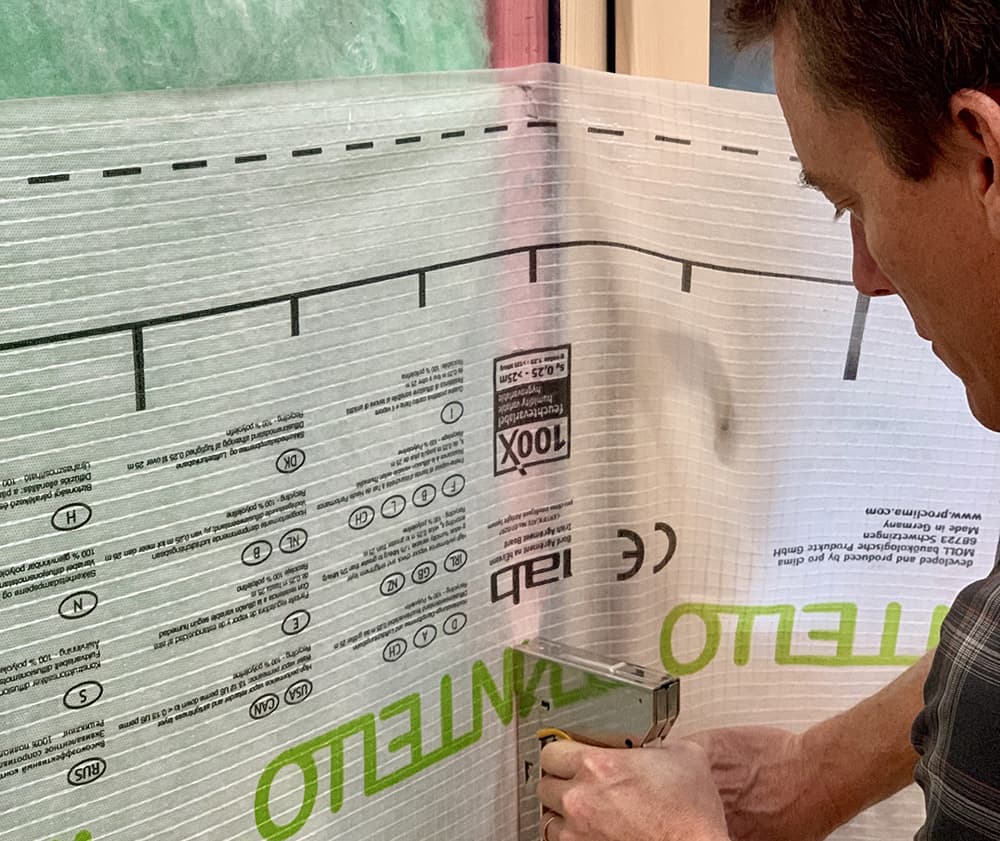
Preformed corner tapes are worth having on site for this detail — window reveals are exactly the awkward, folded corners they’re designed for, and they seal far more reliably than trying to fold flat tape around a corner by hand.
5. Roof penetrations
Roof penetrations are almost always forgotten, because they’re installed by several different trades at different stages, and none of them are thinking about the ceiling as an airtightness layer. Every one of these needs a sealed collar or grommet where it crosses the ceiling:
6. Mechanical ventilation ducts
An MVHR system only delivers the air quality and efficiency it’s designed for if its own ductwork doesn’t leak into the roof space or wall cavities instead of the rooms it’s meant to serve. Every duct penetration through the envelope is a dedicated airtightness detail in its own right:
Duct grommets
An EPDM grommet (e.g. Pro Clima Roflex) seals round ducting through the ceiling or wall in one step.
Membranes
Where the duct crosses a membrane layer, the membrane is cut, sleeved and taped back to the duct — not just slit and left.
Careful taping
Joints and membrane returns are taped with an exterior-rated tape (e.g. Pro Clima Tescon Extora), both for airtightness and to protect MVHR performance.
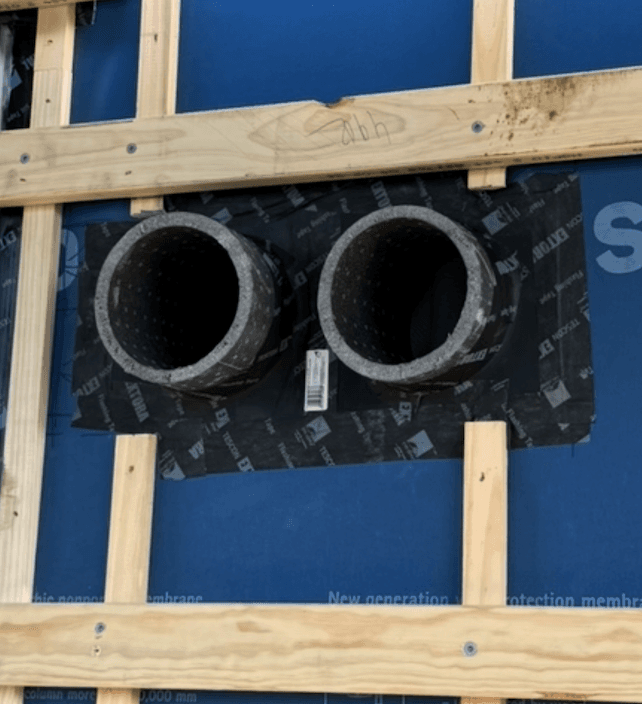
See What Is MVHR? for how the system fits together, and why duct airtightness affects real-world performance as much as the unit specification does.
7. Framing junctions
Anywhere two different building elements meet is a place the airtightness layer can be broken or left discontinuous. The junctions worth checking on every job:
Internal membranes need to be lapped and taped continuously across these junctions, not stopped at the edge of one element and restarted on the next. A membrane that’s airtight everywhere except the corners isn’t an airtight membrane.
8. Electrical boxes
One power point doesn’t matter. Fifty do. A standard electrical box cut into an external wall is a hole in the airtightness layer, and a typical home has dozens of them between power points, switches and data outlets.
Airtight electrical boxes — pre-sealed boxes with grommeted cable entries and a sealing gasket to the wall lining — are worth specifying on external walls where the airtightness layer sits behind the plasterboard. Where standard boxes are used instead, each one needs to be individually sealed to the membrane before the electrician moves on.
Worth remembering: this is a volume problem, not a difficulty problem. Each box takes seconds to seal properly. Multiplied across a whole house, skipping it adds up to a meaningful chunk of total leakage.
9. Rangehood duct
The rangehood duct is one of the largest single penetrations in the entire house — a 150 mm or larger opening straight through the envelope, usually with a damper that’s only doing part of the sealing job on its own.
Seal around each of these separately:
The duct itself
Where it passes through wall or ceiling framing.
The damper
The unit needs to be fitted so its frame is sealed to the wall, not just the duct sealed to the damper.
The surrounding framing
The rough opening cut for the duct is almost always larger than the duct — that gap needs closing too.
A basic backdraft damper stops most air movement when the hood isn’t running, but purpose-built units go further — a Naber Thermobox, for example, uses a multi-flap, magnetically sealed damper that’s tested for airtightness and specifically improves envelope performance while the rangehood is off, rather than just reducing draughts.
For the full picture on rangehoods, make-up air and NCC 2022, see Range Hoods in Airtight Homes.
10. The before-plaster inspection
Everything above is easy to do individually and easy to miss collectively — which is why the last detail is a process, not a product. Before plasterboard goes up, walk every room against a checklist and confirm every penetration is already sealed.
A walkthrough like this takes an hour or two on a typical home. The alternative — finding these gaps after handover — takes far longer and costs far more.
Download the checklists
Free, print-ready PDFs — take them on site, tick them off room by room, and keep a signed copy on file for handover.
Builder Air Sealing Checklist
The master checklist — all 10 details in one document.
Pre-Plaster Airtightness Checklist
A room-by-room walkthrough to run right before lining.
Service Penetration Checklist
Plumbing, electrical, data, refrigeration and gas — one trade per section.
Common air sealing products
None of these products matter if they aren’t used at the right details, in the right sequence. But it helps to know what’s on the shelf and what each one is actually for.
Low-expansion foam
For filling gaps without distorting frames — a thermal filler, not an air seal.
Acrylic airtight sealant
Flexible and paintable. Good for irregular gaps and junctions where tape or a grommet won't sit cleanly.
Air sealing tapes
For membrane joints, duct penetrations and window installation — the primary air barrier at these details, not an afterthought. Pro Clima Tescon Extora is a common exterior-rated example.
Pipe grommets
EPDM grommets such as Pro Clima Roflex are the fastest, most repeatable method for plumbing and duct penetrations.
Cable grommets
Purpose-made grommets such as Pro Clima Kaflex seal single or multiple cables through a membrane or frame.
Preformed corner tapes
Useful around windows and other difficult junctions where flat tape won't fold cleanly into a corner.
A continuous internal airtightness membrane, properly taped at every joint and penetration, is what ties every detail on this page together into a single, continuous air barrier — rather than a collection of well-sealed spots surrounded by gaps.
See Airtightness Explained for how airtightness is measured and what levels to target in South Australian construction.
The cheapest quality assurance you can buy
A blower door test before plasterboard is installed is one of the cheapest forms of quality assurance available. Leaks are visible, accessible and inexpensive to fix before linings go on — smoke pencils show exactly where air is moving, while every detail above is still exposed and easy to reach.
Keep learning
Blower Door Testing
Pre-lining and final testing — how airtightness is measured and verified
Airtightness Explained
What airtightness means and what levels to target
Top 5 Building Mistakes
The envelope mistakes that quietly ruin comfort
Range Hoods in Airtight Homes
Rangehood ducting, make-up air and NCC 2022
What Is MVHR?
Why duct airtightness matters as much as the unit itself
Mould in New Homes
What untreated leakage and thermal bridging lead to
Retrofitting MVHR
Adding ducted or decentralised MVHR to a home that's already built
Frequently asked questions
What is the single biggest air leakage path in a typical home?
There usually isn't one big leak — that's the point. Top plates are often the single largest contributor because every stud bay has a joint, and every service (plumbing, electrical, data) punches through them on its way to the roof space. But a home's total leakage is really the sum of hundreds of small gaps: service penetrations, unfinished window reveals, bottom plates, downlights, exhaust ducts and electrical boxes. Individually, each is minor. Added together, they can be equivalent to leaving a window permanently open.
Why can't these leaks just be sealed after the house is finished?
Some can — with retrofit-grade products and a lot more labour. But most of the highest-value sealing points (top plates, bottom plates, framing junctions, service penetrations inside walls) are only accessible while the frame is exposed. Once plasterboard is fixed, insulation is in, and skirting and architraves are on, these become expensive to access and are often left alone. A gap that takes 30 seconds to seal during framing can require cutting into a finished wall to fix later.
Is expanding foam enough to air seal a window or door?
No, and this is one of the most common misunderstandings on site. Expanding foam is an insulation gap-filler, not an airtight seal — it is not designed or tested as an air barrier, it can shrink, and it doesn't bond reliably to all frame and reveal materials over time. A properly sealed window uses an internal airtight tape to seal the frame to the wall's airtightness layer on the room side, and an external weather-resistant (vapour-open) tape on the outside. Low-expansion foam can still be used to fill the cavity for thermal performance, but it should not be relied on as the air seal.
When should a blower door test be done during construction?
The most useful time is at lock-up, before plasterboard goes up — often called a pre-lining or first-fix test. At this stage every service penetration, top plate, bottom plate, window reveal and framing junction is still visible, and smoke testing under depressurisation can show exactly where air is moving. Any leaks found are fast and cheap to fix. A second, final test after completion then verifies and documents the result.
What products are typically used for air sealing during construction?
Low-expansion foam for filling gaps without distorting frames, acrylic airtight sealant for flexible, paintable joints, purpose-made air sealing tapes for membrane joints and window installation, EPDM pipe grommets (such as Pro Clima Roflex) and cable grommets (such as Pro Clima Kaflex) for service penetrations, and preformed corner tapes for window reveals and other awkward junctions. The products matter less than making sure every penetration and joint actually gets one of them before linings go on.
Written by
Jonathen HindryFounder of HiPer Haus. ATTMA Level 1 Airtightness Tester, Certified Passive House Tradesperson and 25+ year plumber — blower door testing, MVHR design and heat pump hot water across Adelaide and South Australia.
