Decentralised MVHR for Existing Homes
Single-room, through-wall heat recovery ventilation — a practical retrofit option when a full ducted MVHR system isn't possible.
What is decentralised MVHR?
Decentralised MVHR delivers mechanical ventilation with heat recovery on a room-by-room basis. Instead of one central unit pushing fresh air through a network of ducts, compact units install directly through an external wall and supply and extract air locally — recovering heat as they go.
Most decentralised units work on a push-pull cycle. A unit (or a pair of units) alternates between extracting stale air and supplying fresh air through a ceramic heat-exchange core. As warm, stale air is drawn out, the core stores its heat; seconds later the cycle reverses and incoming fresh air is warmed as it passes back through the same core. Run as a pair on opposite sides of a room or home, one unit extracts while the other supplies, then they swap — keeping airflow balanced.
The result is the same core benefit as ducted MVHR — continuous filtered fresh air with most of the heat retained — but without the disruption of running ductwork through an existing home. Heat recovery on quality single-room units typically sits in the region of 70–90%.
The short version
Decentralised MVHR trades whole-home ducting for self-contained units fitted room by room. It’s the most realistic way to add heat-recovery ventilation to a finished house, an apartment, or a few problem rooms — without ripping into ceilings to install a duct network.
How it differs from centralised MVHR
Centralised MVHR is built around a single unit — usually in a plant room, laundry or ceiling void — connected to every room by supply and extract ducts. Fresh air is delivered to living areas and bedrooms while stale, humid air is pulled from bathrooms, kitchens and laundries, all through one balanced system. It’s the gold-standard approach, but it needs space for ducting and is far easier to install before plasterboard goes up.
Decentralised MVHR moves the intelligence into the rooms themselves. Each unit handles its own patch of the house, so there’s no central plant and almost no ductwork. That makes it dramatically easier to retrofit — but it also means more individual units to live with and maintain, and air distribution that is local rather than whole-home.
Both achieve the same goal: replacing uncontrolled draughts with filtered, heat-recovered fresh air. The choice between them is mostly about your building, your construction stage and how much disruption you can accept. For the full picture on the centralised approach, see our guide to what MVHR is and how it works.
Where decentralised MVHR fits
It’s an excellent tool for the right job — and the wrong tool for others. Knowing the difference saves money and avoids disappointment.
Where it works well
Retrofit and single-room scenarios
- Bedrooms — quiet, continuous fresh air to lower overnight CO₂
- Home offices and studies where one room needs better air
- Apartments where a central unit and ducting aren't feasible
- Extensions and additions added to an existing home
- Problem rooms with condensation, stuffiness or lingering damp
- Airtightness upgrades — after new windows, insulation or draught sealing
- Heritage or finished homes where ceilings can't be opened up
Where it isn’t the best solution
When centralised MVHR wins
- New builds, where ducting can be designed in from the start
- Whole-home ventilation with balanced supply and extract everywhere
- Passive House-level projects requiring certified efficiency and balance
- Homes needing precise, documented airflow across many rooms
- Projects where a single quiet plant unit is preferable to many units
- Very low airtightness targets (well under 1 ACH50) demanding tight control
For these, a ducted system delivers better balance, efficiency and acoustics. See MVHR design & installation.
Common decentralised unit types
Decentralised MVHR isn’t one product. The right type depends on the room, the wall and how much airflow you need.
Paired push-pull ceramic core units
Small units installed in pairs, each with a regenerative ceramic core. They alternate every 60–70 seconds — one extracting while the other supplies, then reversing — so heat is captured and returned and the room stays pressure-balanced. The classic decentralised approach for living spaces and bedrooms.
- Run in balanced pairs
- Regenerative ceramic heat core
- Whisper-quiet on low speed
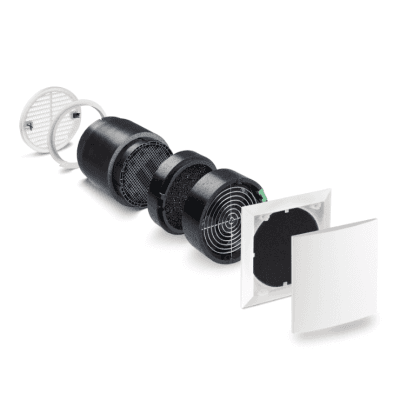
Lunos e² — paired push-pull
Continuous single-room units
A single self-contained unit with both airstreams built in, running supply and extract continuously through one wall opening with a counter-flow heat exchanger. No second unit to pair, so it can ventilate a room on its own — useful where only one external wall is available.
- One unit, one wall penetration
- Continuous balanced airflow
- Built-in filtration
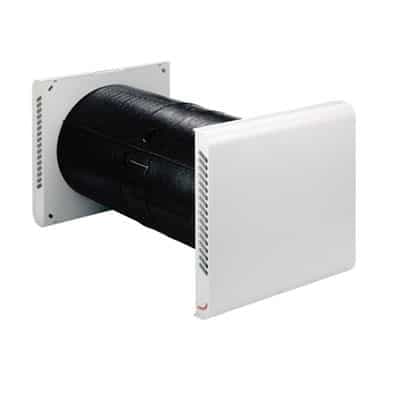
Zehnder ComfoSpot 50
Small ducted / local units
Compact wall-mounted heat-recovery units that can take short lengths of duct to serve one or two nearby rooms — for example a unit on a bedroom wall with a short run carried through to an adjoining ensuite. A middle ground between fully decentralised and fully ducted, ideal for additions and small zones.
- Serves a small zone or 1–2 rooms
- Wall-mounted, with short local duct runs
- Higher airflow than basic wall units
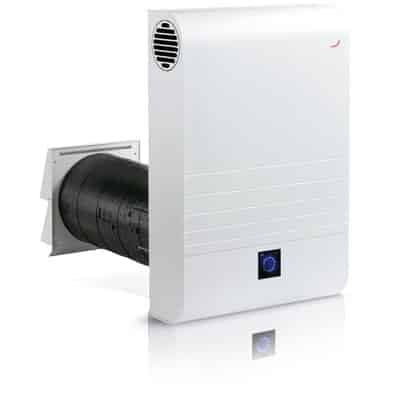
Zehnder ComfoAir 70 (CA70)
Brands shown are examples. We also specify Aerofresh and other similar single-room heat recovery units, selected to suit the room, wall construction and airflow required.
Pros and cons
Decentralised MVHR is a genuine solution, not a compromise — provided you go in with clear eyes about what it does and doesn’t do.
Advantages
- Far easier to retrofit — no whole-home duct network
- Low disruption — most rooms done in a day, home stays liveable
- Room-by-room control — ventilate only where you need it
- Start small and expand — add rooms over time, spread cost
- Ideal for apartments, extensions and heritage buildings
- Lower up-front cost for a single room than a full system
Things to weigh up
- More external wall penetrations across the home
- Visible internal and external grilles in each room
- Acoustic considerations — choose quality units, mind speeds
- Maintenance across multiple units rather than one
- Local rather than whole-home balanced air distribution
- Per-room cost adds up if you ventilate the whole house
Decentralised MVHR in Adelaide homes
A lot of Adelaide and South Australian homes are quietly becoming more airtight. New double-glazed windows, ceiling and wall insulation, and draught sealing all make a house more comfortable and cheaper to run — but they also close off the accidental draughts that used to ventilate it. The home that used to “breathe” through gaps no longer does.
The signs show up in winter: condensation streaming down windows in the morning, stuffy bedrooms, lingering bathroom steam, and the early specks of mould in corners and behind furniture. Closed-up bedrooms also let CO₂ climb overnight, which is a common and overlooked cause of waking up tired or with a headache.
For an existing home that’s already finished, running ducting for a centralised system is often impractical. Decentralised MVHR fits this gap neatly — adding controlled, heat-recovered fresh air to the rooms that need it most, without tearing the house apart.
Decentralised or centralised MVHR?
A quick side-by-side to point you in the right direction. The best choice depends on your building and stage — we’re happy to advise.
| Consideration | Decentralised MVHR | Centralised MVHR |
|---|---|---|
| Best for | Retrofits, single rooms, apartments, extensions | New builds and major renovations |
| Ductwork | None to minimal — through-wall units | Full supply & extract duct network |
| Disruption | Low — home stays liveable | High — best before plasterboard |
| Air distribution | Local, room by room | Balanced across the whole home |
| Heat recovery | ~70–90% (quality units) | ~80–92% |
| Number of units | Multiple — one per room or pair | One central unit |
| Maintenance | Filters across several units | Filters in one accessible unit |
| Passive House | Not typically certified-grade | The standard approach |
| Staged install | Yes — add rooms over time | Installed as one system |
Book a ventilation assessment
Whether you need fresh air in one bedroom or a plan for the whole home, we’ll assess your rooms, airtightness and problem areas and recommend the right approach — decentralised, centralised, or a mix of both.
Written by
Jonathen HindryFounder of HiPer Haus. ATTMA Level 1 Airtightness Tester, Certified Passive House Tradesperson and 25+ year plumber — blower door testing, MVHR design and heat pump hot water across Adelaide and South Australia.
