Heat Recovery Ventilation Systems, Explained
MVHR, HRV, ERV, balanced ventilation — different names for the same idea. A plain-English guide to what heat recovery ventilation is, which type suits your climate, and what changes in your home.
Key takeaways
- A heat recovery ventilation system continuously supplies fresh filtered air and extracts stale air, recovering most of the heat that would otherwise be lost.
- MVHR, HRV, ERV, balanced ventilation and “heat recovery ventilation system” all describe the same underlying technology — the differences are mostly in terminology and core type, not the concept.
- HRV cores recover heat only; ERV cores also moderate moisture transfer between the airstreams. HRV is often the starting point in cooler climates and ERV in warmer, humid ones — but the right choice depends on your specific climate and building, not just your postcode.
- It comes in two forms: centralised (ducted, whole-home) and decentralised (through-wall, room-by-room) — see the comparison below.
- It isn't a replacement for heating, cooling or a bathroom exhaust fan. It solves a different problem: continuous, filtered, heat-recovered fresh air.
Why does this technology have so many names?
Search for “fresh air system,” “whole house ventilation,” “mechanical ventilation” or “heat recovery ventilation system” and you’ll find yourself reading about the same technology under a different name each time. That’s not an accident of marketing — it’s the result of the same product category evolving separate vocabularies in different industries and regions.
Building certifiers and Passive House professionals in Australia and Europe use MVHR (Mechanical Ventilation with Heat Recovery) as the technical umbrella term. North American manufacturers and homeowners use HRV and ERV to distinguish between two different core types. And most Australian homeowners, who’ve never heard any of that jargon, simply search for what it does — a heat recovery ventilation system, or a fresh air system for their home.
Google understands these terms are related. Homeowners usually don’t — which is exactly why this guide exists. The table below maps every term to what it actually means.
One technology, five names
Every term below describes the same category of system, or a specific variant of it. None of them are competing technologies.
| Term | What it means | Same as MVHR? |
|---|---|---|
| MVHR (Mechanical Ventilation with Heat Recovery) | The industry and technical term for balanced ventilation with a heat-recovering core — the umbrella term for everything on this page. | The umbrella term |
| HRV (Heat Recovery Ventilator / Ventilation) | A type of MVHR whose core transfers heat only, not moisture (“sensible heat” recovery). A North American term increasingly used by Australian homeowners. | Yes — a sensible-only MVHR |
| ERV (Energy Recovery Ventilator / Ventilation) | A type of MVHR whose core also allows some moisture to transfer between the two airstreams, moderating the moisture load on the home (“enthalpy” recovery). The direction depends on the humidity difference between inside and outside air, not a fixed rule. Also a North American term. | Yes — a moisture-moderating MVHR |
| Balanced ventilation | A generic description of matched, continuous supply and extract airflow. Only counts as heat recovery ventilation if the system includes a heat-exchanger core. | Only if it recovers heat |
| Heat recovery ventilation system | The plain-English, consumer-facing name for the same technology — how most Australian homeowners describe it when searching. | Yes — same as MVHR |
HRV vs ERV in Australia
HRV is often the starting point in cooler, heating-dominated southern climates, while ERV is often considered in warmer, more humid northern ones. Final selection depends on the exact climate, occupancy, cooling strategy, airtightness and indoor-humidity goals — not on which state you live in.
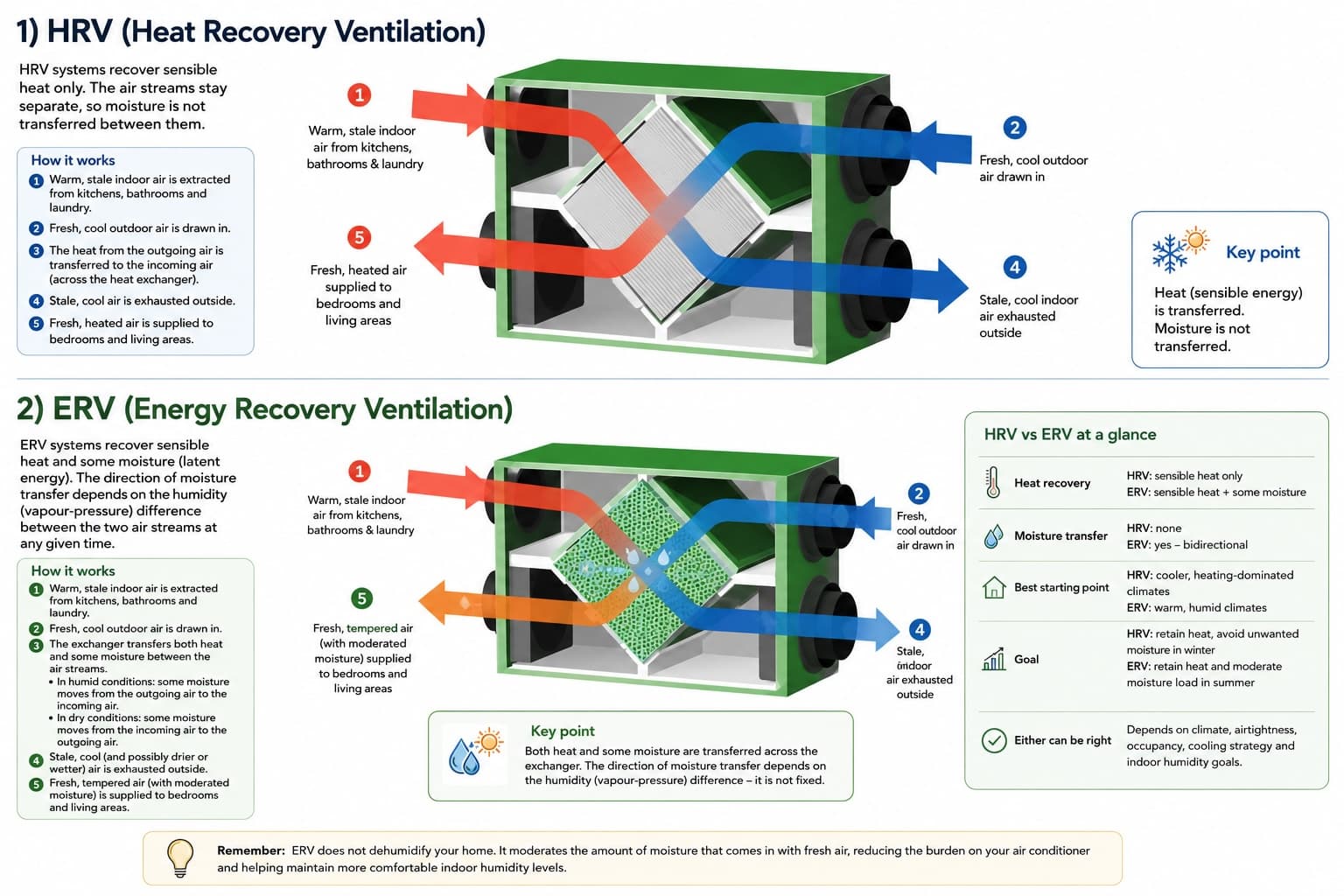
ERV doesn’t dehumidify a home — it moderates how much moisture comes in with the fresh air, easing the load on your air conditioner.
| Region | Often considered | Why |
|---|---|---|
| SA, VIC, TAS, ACT, cooler NSW | HRV often the starting point | Cooler, heating-dominated climates, where a simpler sensible-heat core is usually adequate — though this is a starting point, not a rule. |
| Sydney & central NSW | Either, project-specific | A transitional climate where the right core type depends on the individual building and brief rather than a regional default. |
| Northern NSW & SE Queensland | ERV often considered | Warmer, more humid conditions, where moderating moisture transfer between the airstreams is usually worth factoring in. |
| Tropical Queensland & NT | ERV often considered | High humidity for much of the year and long cooling seasons, where moisture moderation is usually a bigger priority. |
There’s no hard state-based rule. Climate zone, orientation, occupancy patterns and whether a home is heating- or cooling-dominated all influence the right core type — not postcode alone. We assess this for every project rather than defaulting to a regional assumption.
Supply, extract, recover
Every heat recovery ventilation system — regardless of what you call it — runs two simultaneous airstreams: one supplying fresh filtered air to living areas, one extracting stale, humid air from wet rooms, with heat (and in ERV systems, some moisture) transferring between them in the core.
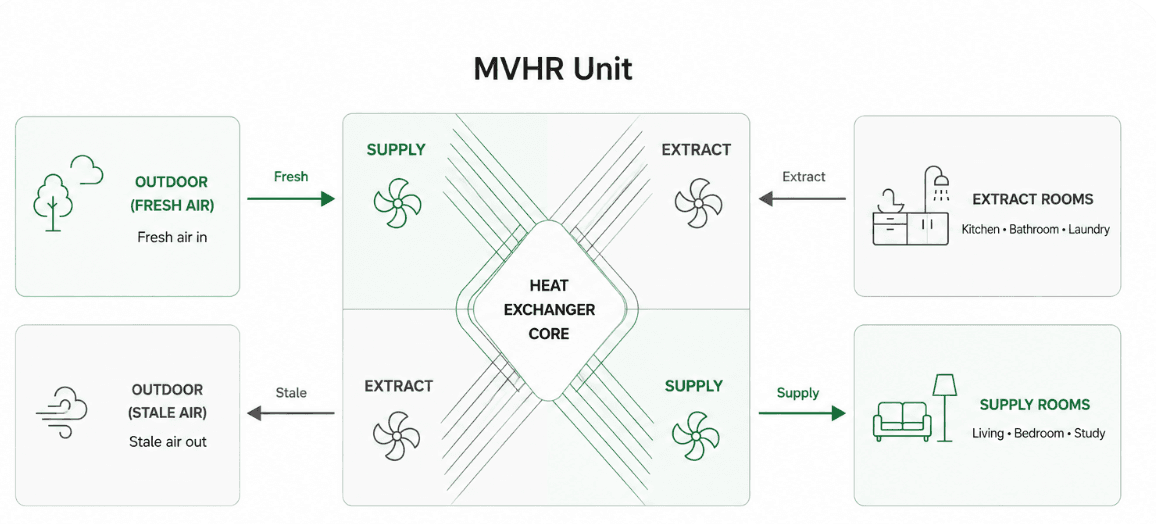
The two airstreams never mix. Heat — and, in ERV systems, some moisture — transfers across the exchanger core.
Centralised or decentralised?
Once you’ve settled on heat recovery ventilation, the next decision is how it’s delivered. Both achieve the same result — the right choice depends on your building and construction stage.
Centralised MVHR
Best for new builds and major renovations
A single unit distributes fresh air across the whole home via ducting, while extracting stale, humid air from bathrooms, kitchens and laundries. Highest heat recovery efficiency, whole-home coverage, one system to maintain.
Centralised MVHR — the full guide →Decentralised MVHR
Best for retrofits, apartments and staged upgrades
Compact, room-based units install through an external wall — no ductwork required. Ideal where a full ducted system isn’t practical due to space, budget or disruption, and can be added room by room over time.
Decentralised MVHR — the full guide →Heat recovery ventilation vs...
It’s easy to assume you already have a version of this. Here’s how it actually differs from the alternatives people reach for first.
vs. opening windows
Opening windows exchanges air, but with no filtration and no heat recovery — every bit of conditioned air you paid to heat or cool escapes outside, and whatever's in the outdoor air (pollen, dust, traffic pollution) comes straight in. Heat recovery ventilation filters incoming air and keeps most of the energy you've already spent.
vs. bathroom exhaust fans
An exhaust fan is single-room, one-way extraction — it removes air but doesn't supply anywhere near enough replacement air in an airtight home, and it recovers no heat at all. Heat recovery ventilation is balanced and whole-home: supply and extract happen together, continuously, with heat recovered in the process.
vs. air conditioning
Air conditioning recirculates and conditions the air already inside your home — it doesn't bring in fresh outdoor air. Heat recovery ventilation and air conditioning solve different problems and work together well: ventilation handles fresh air and indoor air quality, air conditioning handles temperature.
Do I need heat recovery ventilation?
Not every home needs it immediately — but the signs below are common in modern, well-sealed Australian homes, and each one usually means the building is holding onto air (and moisture) it can no longer get rid of naturally.
One of the most important numbers in your home is one most people never check. See our guide to relative humidity to understand what the healthy range is and how ventilation controls it.
Heat recovery ventilation, installed across South Australia
The right heat recovery ventilation system starts with knowing how airtight a building actually is — that’s what a blower door test establishes before we recommend a system. These two projects show both ends of that process: a pre-renovation airtightness baseline, and a decentralised heat recovery installation in an existing home.
Blower Door Test · Nairne, Adelaide Hills
Blower Door Test — Nairne, Adelaide Hills
A pre-renovation airtightness test on an existing home at Nairne in the Adelaide Hills, ahead of a planned extension. We set up a Retrotec blower door to measure how leaky the existing building fabric is — establishing a baseline before the works so air-sealing can be targeted where it matters most.
View project →Retrofit · Mount Gambier
Decentralised MVHR Retrofit — Mount Gambier
A decentralised heat recovery retrofit in an existing limestone home at Mount Gambier. The solid limestone walls were lined with a false wall and a building membrane to manage moisture, and a Zehnder ComfoSpot 50 single-room heat recovery unit was core-drilled through the wall — delivering continuous filtered fresh air with heat recovery and no central ductwork.
View project →MVHR Retrofit · Nairne, Adelaide Hills
MVHR Retrofit — Nairne, Adelaide Hills
A full Altair 160 MVHR retrofit into our own existing, occupied Adelaide Hills home — the same house that tested at 12.5 ACH50 before any airtightness work. We use it as a live test bench for developing our services: a custom Home Assistant integration over Modbus and an automatic shower-boost sensor sit alongside the retrofit itself, turning the house into an ongoing, heavily monitored ventilation research platform.
View project →Frequently asked questions
What is a heat recovery ventilation system?
A heat recovery ventilation system continuously replaces stale indoor air with fresh outdoor air while recovering most of the heat (and sometimes moisture) that would otherwise be lost. Incoming and outgoing air pass through a heat-exchanger core without mixing, so you get constant fresh air without the energy penalty of simply opening a window. MVHR, HRV and ERV all describe this same category of system.
Is heat recovery ventilation the same as MVHR?
Yes. MVHR (Mechanical Ventilation with Heat Recovery) is the technical, industry-standard name for a heat recovery ventilation system. It's the term you'll see used by Passive House professionals, building certifiers and tradespeople across Australia and Europe — while “heat recovery ventilation” and “heat recovery ventilation system” are how most homeowners describe and search for the same thing.
What's the difference between HRV and ERV?
Both recover sensible heat while keeping the two airstreams separate. An ERV (Energy Recovery Ventilator) core also allows some moisture to transfer between the outgoing and incoming air, moderating the moisture load the system places on the home — the direction and amount depend on the humidity difference between inside and outside air at the time, not a fixed rule. An HRV (Heat Recovery Ventilator) core transfers heat only. ERV is often considered in warm, humid climates and HRV in cooler, heating-dominated ones, but the right choice depends on your specific climate, occupancy and airtightness — see our HRV vs ERV in Australia section below.
Do I need heat recovery ventilation in Australia?
If your home is airtight — new builds, renovations with new windows and insulation, or anything targeting 5 ACH50 or better — yes. Airtight construction removes the accidental draughts that used to provide fresh air, so a home needs a deliberate replacement or it accumulates CO₂, moisture and indoor pollutants. Heat recovery ventilation is that replacement, and it's mandatory for Passive House certification.
Does heat recovery ventilation replace air conditioning?
No. Heat recovery ventilation manages fresh air, humidity and indoor air quality — it doesn't heat or cool your home to a set temperature. Most high-performance homes run both: heat recovery ventilation for continuous fresh air, and a right-sized heating and cooling system for temperature. See our guide to heating and cooling for Passive Houses for how the two work together.
Can heat recovery ventilation be added to an existing home?
Yes, in two ways. A full ducted (centralised) system can be retrofitted, though it's more disruptive than installing during construction. Decentralised, through-wall units avoid ductwork entirely and can add heat recovery ventilation room by room — a common choice for bedrooms, apartments and heritage homes where opening up ceilings isn't practical.
Is heat recovery ventilation noisy?
A properly designed system should be inaudible in bedrooms and living areas. Noise is almost always a sign of a design or installation fault — undersized ducts, poor terminal placement or missing attenuators — rather than a limitation of the technology. This is why duct sizing and routing should be planned before installation, not fitted around a finished build.
How much maintenance does heat recovery ventilation need?
Heat recovery ventilation is low-maintenance, not no-maintenance. Filters typically need replacing every 6–12 months, and an annual airflow check keeps the system performing as designed. Centralised systems concentrate this into one accessible unit; decentralised systems spread it across several smaller units.
Is heat recovery ventilation mandatory for new homes in Australia?
It depends on your state's adoption of the National Construction Code and the project's selected pathway. NCC 2022 H6V3 is an optional building-envelope sealing Verification Method that requires mechanical ventilation when its measured air-permeability threshold is met. This is not a universal ACH50 trigger. South Australian homeowners can see the current dates and pathway detail in our SA NCC guide.
What's the difference between heat recovery ventilation and a bathroom exhaust fan?
A bathroom exhaust fan only extracts air from one room, pulling in replacement air from wherever it can find a gap — which, in an airtight home, is often nowhere. Heat recovery ventilation supplies fresh filtered air and extracts stale air continuously and everywhere, in a balanced, heat-recovering system rather than a single-room, one-way fan.
Not sure which system is right for your home?
We’ll assess your building, climate and airtightness target and recommend the right heat recovery ventilation approach — centralised, decentralised, HRV or ERV.
Written by
Jonathen HindryFounder of HiPer Haus. ATTMA Level 1 Airtightness Tester, Certified Passive House Tradesperson and 25+ year plumber — blower door testing, MVHR design and heat pump hot water across Adelaide and South Australia.
